Difference between pages "Storage" and "ATI"
(→SD to IDE Adapters:) |
(→R300) |
||
| Line 1: | Line 1: | ||
| + | ATi Technologies produced graphics cards from the '80s through the mid '00s until merging with AMD in 2006. AMD still produces graphics cards today. | ||
| − | === | + | == ATi Wonder Series == |
| − | |||
| − | |||
| − | |||
| − | |||
| − | |||
| − | |||
| − | ''' | + | The '''ATi Wonder series''' represents some of the first [[graphics]] add on products for [[IBM]] [[Personal computer|PCs]] and compatibles introduced by [[ATi Technologies]] in the mid to late 1980s. These cards were unique at the time as they offered the end user a considerable amount of value by combining support for multiple graphics standards (and monitors) into a single card. The VGA Wonder series added additional value with the inclusion of a [[Bus mouse|bus mouse port]], which normally required the installation of a dedicated [[Microsoft Bus Mouse]] adapter. |
| − | |||
| − | |||
| − | |||
| − | + | The VGA Wonder series later merged with the [[ATI Mach]] series of cards in 1990. The [[ATi Graphics Ultra]] (VRAM) and [[ATi Graphics Vantage]] (DRAM) cards both featured independent VGA Wonder ASICs in addition to their Mach8 8514 compatible [[coprocessor chips]]. The Graphics Ultra was later renamed the VGA Wonder GT. In 1992, their following [[product line]], the Mach32, integrated the VGA wonder core and coprocessor into a single IC. At this point the VGA Wonder line was cancelled and replaced with a cost reduced DRAM based version of Mach32 known as the "ATi Graphics Wonder". | |
| − | |||
| − | |||
| − | |||
| − | |||
| − | |||
| − | |||
| − | ''' | + | ===Graphics Solution (CGA)=== |
| − | + | [[File:ATI Hercules Card 1986.xcf|thumb|One of the early graphics cards from ATI Technologies: a ''Graphics Solution Rev 3'' [[Hercules Graphics Card|Hercules]] graphics card from 1986. As can be seen from the PCB the layout was done in 1985, whereas the marking on the central chip CW16800-A says "8639" meaning that chip was manufactured week 39, 1986.]] | |
| − | + | ''Release Date: 1986'' | |
| − | |||
| − | |||
| − | |||
| − | |||
| − | |||
| − | |||
| − | ''' | + | '''ATi Graphics Solution Rev 3''' |
| − | * | + | * [[Chipset]]: ATI CW16800-A |
| − | * | + | * Supports: [[Hercules Graphics Card]] mode |
| − | * | + | * Port: 8-bit PC/XT bus |
| − | |||
| − | + | '''ATi Color Emulation Card ''' | |
| + | * Did at least support CGA graphics output to a [[TTL Monochrome]] monitor | ||
| − | ''' | + | '''ATi Graphics Solution plus (1987)''' |
| − | * | + | * [[Chipset]]: ATI CW16800-B |
| − | * | + | * Supports CGA, [[Plantronics Colorplus]] CGA & [[Hercules Graphics Card]] graphics modes |
| − | + | * Compatible with MDA, CGA (and therefore also EGA displays), [[DIP switch]] selectable | |
| − | * | + | * 64kb of DRAM |
| − | * | + | * Port: 8-bit PC/XT bus |
| − | * | + | '''Graphics Solution Plus SP''' |
| + | * Chipset: ATI CW16800-B | ||
| + | * Adds Serial/Parallel Ports | ||
| + | '''Graphics Solution SR''' | ||
| + | * Chipset: ATI CW16800-B | ||
| + | * Uses Static RAM | ||
| + | '''ATi Small Wonder Graphics Solution (1988)''' | ||
| + | * Chipset: ATI 18700 | ||
| + | * Also known as Graphics Solution Single Chip or just GS-SC | ||
| + | * Single-chip version of the Graphics Solution plus | ||
| + | * 64kb of static RAM | ||
| + | * Composite Output | ||
| + | '''Graphics Solution Single Chip or GS-SC with Game (1988)''' | ||
| + | * Includes a [[game port]] | ||
| + | * Lacks external [[composite connector]] | ||
| − | ''' | + | :{| class="wikitable" |
| − | * | + | |- |
| − | * Uses the | + | ! scope="col"|Product Name |
| − | * | + | ! scope="col"|Part Number |
| − | * | + | ! scope="col"|GPU Chip |
| − | * | + | ! scope="col"|Bus |
| − | * | + | ! scope="col"|FCC Date |
| + | ! scope="col"|Mode | ||
| + | ! scope="col"|Mem Size | ||
| + | ! scope="col"|Mem Type | ||
| + | ! scope="col"|FCCID | ||
| + | ! scope="col"|Notes | ||
| + | |- | ||
| + | |Graphics Solution | ||
| + | |168228 | ||
| + | |CW16800-A | ||
| + | |XT | ||
| + | |1985 | ||
| + | |CGA, MDA | ||
| + | |64KB | ||
| + | |SRAM | ||
| + | |EXM5RSGSO | ||
| + | | | ||
| + | |- | ||
| + | |Color/Emulation Card | ||
| + | |168230-1 | ||
| + | |CW16800-A | ||
| + | |XT | ||
| + | |1985 | ||
| + | |CGA | ||
| + | |64KB | ||
| + | |SRAM | ||
| + | | | ||
| + | |Versions 1-4? | ||
| + | |- | ||
| + | |Graphics Solution Plus | ||
| + | |168248 | ||
| + | |CW16800-B | ||
| + | |XT | ||
| + | |1986 | ||
| + | |CGA, MDA | ||
| + | |64KB | ||
| + | |SRAM | ||
| + | |EXM5RSGSO | ||
| + | | | ||
| + | |- | ||
| + | |Graphics Solution-SR | ||
| + | |168328 | ||
| + | |CW16800-C | ||
| + | |XT | ||
| + | |1987 | ||
| + | |CGA, MDA | ||
| + | |64KB | ||
| + | |SRAM | ||
| + | |EXM5RSGSSR | ||
| + | | | ||
| + | |- | ||
| + | |Small Wonder | ||
| + | |18701 | ||
| + | |18700 | ||
| + | |XT | ||
| + | |1988 | ||
| + | |CGA, MDA | ||
| + | |64KB/128KB | ||
| + | |dram | ||
| + | |EXM5RSGSSC | ||
| + | | | ||
| + | |- | ||
| + | |Graphics Solution-SC | ||
| + | |18703 | ||
| + | |18700 | ||
| + | |XT | ||
| + | |1988 | ||
| + | |CGA, MDA | ||
| + | |64KB/128KB | ||
| + | |SRAM | ||
| + | |EXM5RSGSSC1 | ||
| + | |Versions 1-2 ? | ||
| + | |- | ||
| + | |Graphics Solution-SC | ||
| + | |109005100 | ||
| + | |16800-C | ||
| + | |XT | ||
| + | |1988 | ||
| + | |CGA, MDA | ||
| + | |64KB | ||
| + | |SRAM | ||
| + | |EXM5RSGSSC2NC | ||
| + | |Versions 1-3? | ||
| + | |- | ||
| + | |Graphics Solution-SC WITH GAME | ||
| + | |109003200 | ||
| + | |18700 | ||
| + | |XT | ||
| + | |1988 | ||
| + | |CGA, MDA | ||
| + | |64KB | ||
| + | |dram | ||
| + | |EXM5RSGSSCGM | ||
| + | | | ||
| + | |} | ||
| + | |||
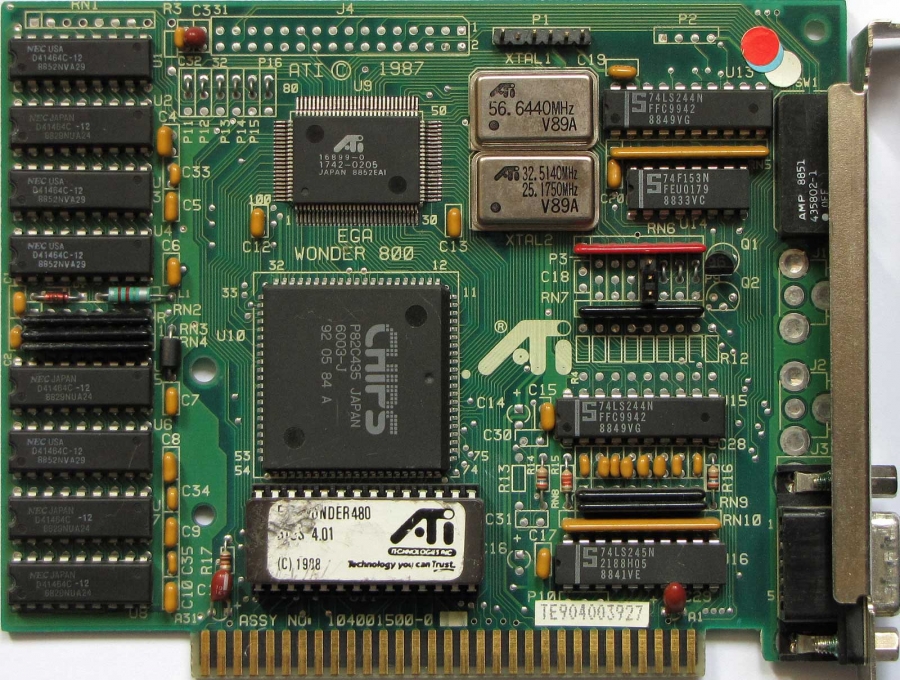
| + | ===EGA Wonder=== | ||
| + | ''Release Date: 1987'' | ||
| + | |||
| + | '''ATi EGA Wonder''' (March 1987) | ||
| + | * Chipset: ATI16899-0 + CHIPS P86C435 | ||
| + | * Supports CGA, Hercules mono & EGA graphics modes | ||
| + | * Removes support for plantronics mode/Single-page Hercules mode/composite output | ||
| + | * Compatible with MDA, CGA and EGA displays (DIP switch selectable) | ||
| + | * [[Internal composite port]] for machines such as [[IBM 5155 Portable]] | ||
| + | * 256kb DRAM | ||
| + | * Port: 8-bit PC/XT bus | ||
| + | * Original MSRP: $399 | ||
| + | '''ATi EGA Wonder 800''' | ||
| + | * Added support for extended EGA text and graphics modes (requires [[multisync monitor]]) | ||
| + | * Added support for 16-colour VGA modes | ||
| + | '''ATi EGA Wonder 800+''' | ||
| + | * Rebadged VGA Edge lacking the analogue [[VGA port]] | ||
| + | * Chipset: ATI 18800 | ||
| + | * Can auto-detect monitor type connected (DIP switches no longer present) | ||
| + | |||
| + | :{| class="wikitable" | ||
| + | |- | ||
| + | ! scope="col"|Product Name | ||
| + | ! scope="col"|Part Number | ||
| + | ! scope="col"|GPU Chip | ||
| + | ! scope="col"|Bus | ||
| + | ! scope="col"|FCC Date | ||
| + | ! scope="col"|Mode | ||
| + | ! scope="col"|Mem Size | ||
| + | ! scope="col"|Mem Type | ||
| + | ! scope="col"|FCCID | ||
| + | ! scope="col"|Notes | ||
| + | |- | ||
| + | |EGA Wonder | ||
| + | |16890, 16892 | ||
| + | |ATI16899-0 | ||
| + | |XT | ||
| + | |1986-11-13 | ||
| + | |EGA | ||
| + | |256KB | ||
| + | |dram | ||
| + | |EXM5RSEGA0 | ||
| + | |Series 1 through 4 | ||
| + | |- | ||
| + | |[[http://www.vgamuseum.info/media/k2/items/cache/4d8c9898b5bb88437f053c8b957f47f3_XL.jpg EGA Wonder 800]] | ||
| + | |16900, 1040015-0xx | ||
| + | |ATI16899-0 | ||
| + | |XT | ||
| + | |1988-08-09 | ||
| + | |EGA | ||
| + | |256KB | ||
| + | |dram | ||
| + | |EXM5RSEGA2 | ||
| + | |Repackaged at reduced cost as "EGA Wonder 480" | ||
| + | |- | ||
| + | |[[http://www.vgamuseum.info/images/palcal/ati/16899-0vip1b.jpg EGA Wonder VIP]] | ||
| + | |18008 | ||
| + | |ATI16899-0 | ||
| + | |XT | ||
| + | |1987-10-01 | ||
| + | |EGA | ||
| + | |256KB | ||
| + | |dram | ||
| + | |EXM5RSVIP1 | ||
| + | |Rev 1-5 | ||
| + | |- | ||
| + | |EGA Wonder 800+ | ||
| + | |109006000 | ||
| + | |Wonder | ||
| + | |XT | ||
| + | |1989-06-01 | ||
| + | |EGA | ||
| + | |256KB | ||
| + | |dram | ||
| + | |EXM5RSVGA8B1 | ||
| + | |Sold as "VGA Edge-8" when board has VGA port | ||
| + | |} | ||
| + | |||
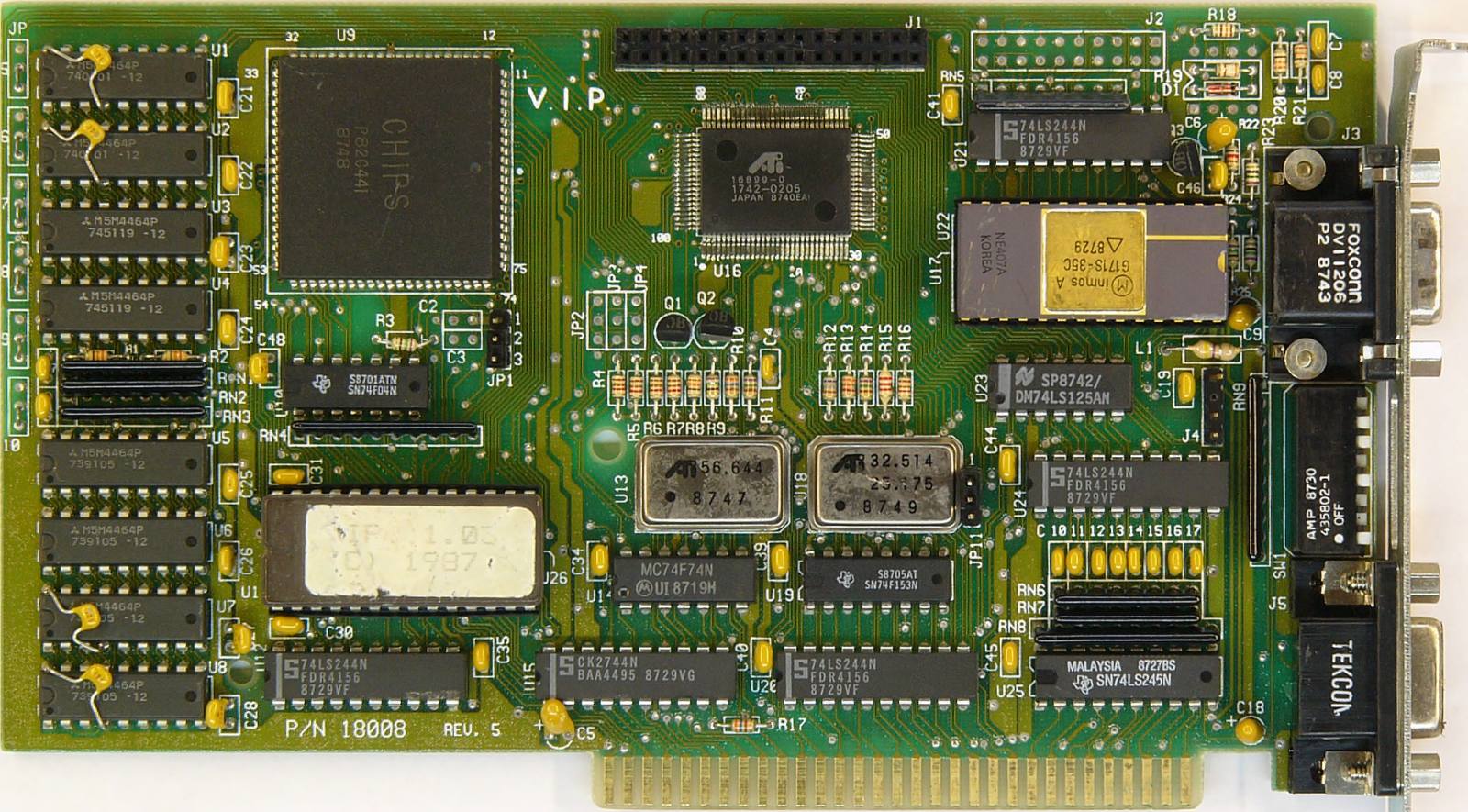
| + | ===VGA Wonder=== | ||
| + | ''Release Date: 1987'' | ||
| + | |||
| + | '''ATi VIP or VGA Improved Performance (1987)''' | ||
| + | |||
| + | * Chipset: ATi 16899-0 & Chips P82C441 | ||
| + | * Supports CGA, Hercules mono, EGA & VGA graphics with Softsense automatic mode switching | ||
| + | * Compatible with MDA, CGA, EGA and VGA displays (DIP switch selectable) | ||
| + | * 9-pin TTL and 15-pin analogue connectors | ||
| + | * 256kb DRAM | ||
| + | * Port: 8-bit PC/XT bus | ||
| + | * Original MSRP: $449 ($99 for Compaq expansion module) | ||
| + | '''ATi VGA Wonder (1988)''' | ||
| + | * Chipset: ATI 18800 | ||
| + | * Adds support for SVGA graphics modes | ||
| + | * Adds support for monitor auto-sensing (switchless configuration) | ||
| + | * Uses on-board EEPROM to store configuration information | ||
| + | * 256kb or 512kb DRAM | ||
| + | * Port: 8-bit PC/XT bus | ||
| + | '''ATi VGA Edge 8''' | ||
| + | * Cost Reduced VGA Wonder | ||
| + | * 256KB DRAM | ||
| + | '''ATi VGA Wonder 16 (1988)''' | ||
| + | * Speed enhancements due to a wider bus | ||
| + | * VGA pass through connector | ||
| + | * Bus mouse connector | ||
| + | * 256KB or 512KB DRAM | ||
| + | * Port: [[16-bit]] PC/AT bus (ISA), [[8-bit]] compatible | ||
| + | * Original MSRP: $499 or $699 respectively | ||
| + | '''ATi VGA Edge-16''' | ||
| + | * Cost reduced VGA Wonder 16 | ||
| + | * Lacks the bus mouse connector and the digital TTL output | ||
| + | * 256kb DRAM (not expandable to 512kb) | ||
| + | '''ATi VGA Wonder+ (1990)''' | ||
| + | [[File:ATI Wonder.jpg|right|thumb|ATI VGA Wonder+]] | ||
| + | * Chipset: ATI 28800-2, -4, or -5 | ||
| + | * Based on a new chipset which claimed to offer speeds rivalling VRAM based cards | ||
| + | * Dual page mode memory access | ||
| + | * Dynamic CPU/CRT interleaving | ||
| + | * 256KB or 512KB DRAM | ||
| + | '''ATi VGA Integra (1990)''' | ||
| + | * Cost reduced version based on new ATi 28800 ASIC | ||
| + | * Lacks bus mouse connector | ||
| + | * Uses a much smaller PCB with a surface mount BIOS & RAMDAC | ||
| + | * Supports SVGA Graphics with 72 Hz refresh rates | ||
| + | * 512KB DRAM | ||
| + | '''ATi VGA Basic-16 (1990)''' | ||
| + | * PCB layout similar to VGA Integra but using cheaper RAMDAC | ||
| + | * Only supports the basic 60 Hz VGA modes of the IBM VGA standard from 1987 | ||
| + | * 256KB DRAM (not upgradable) | ||
| + | '''ATi VGA Charger (1991)''' | ||
| + | * Similar to VGA Basic-16, but can be upgraded to 512KB | ||
| + | '''ATi VGA Wonder XL (May 1991)''' | ||
| + | * Sierra RAMDAC adds support for 15-bit colour in 640x480@72 Hz, 800x600@60 Hz | ||
| + | * Supports a flicker-free vertical refresh rate of 72 Hz | ||
| + | * 256KB, 512KB or 1MB DRAM | ||
| + | * Original MSRP: $229, $349, $399 respectively | ||
| + | '''ATi VGA Stereo·F/X''' | ||
| + | [[File:Vgafx.JPG|400px|right|thumb|ATi VGA Stereo·F/X]] | ||
| + | * Chipset: ATI 28800 | ||
| + | * Combines a VGA Wonder XL with a Sound Blaster 1.5 | ||
| + | * Features "fake" stereo sound | ||
| + | * 512KB or 1MB DRAM | ||
| + | '''ATi VGA Wonder XL24 (1992)''' | ||
| + | * Contains a Brooktree Bt481KPJ85 RAMDAC that adds support for hi and true colour graphics modes | ||
| + | * 512KB or 1MB DRAM | ||
| + | '''ATi VGA Wonder 1024''' | ||
| + | * A series of OEM cost reduced versions of several VGA Wonder models | ||
| + | * Typically lacks the bus mouse connector and/or the digital TTL output | ||
| + | |||
| + | :{| class="wikitable" | ||
| + | |- | ||
| + | ! scope="col"|Product Name | ||
| + | ! scope="col"|Part Number | ||
| + | ! scope="col"|GPU Chip | ||
| + | ! scope="col"|Bus | ||
| + | ! scope="col"|FCC Date | ||
| + | ! scope="col"|Mode | ||
| + | ! scope="col"|Mem Size | ||
| + | ! scope="col"|Mem Type | ||
| + | ! scope="col"|FCCID | ||
| + | ! scope="col"|Notes | ||
| + | |- | ||
| + | |VGA Improved Performance (VIP) | ||
| + | |18008 | ||
| + | |ATI16899-0 | ||
| + | |XT | ||
| + | |1987-10-01 | ||
| + | |VGA | ||
| + | |256KB | ||
| + | |dram | ||
| + | |EXM5RSVIP1 | ||
| + | | | ||
| + | |- | ||
| + | |VGA Wonder-8 | ||
| + | |109006000 | ||
| + | |Wonder | ||
| + | |XT | ||
| + | |1989-06-01 | ||
| + | |SVGA | ||
| + | |256KB | ||
| + | |dram | ||
| + | |EXM5RSVGA8B1 | ||
| + | | | ||
| + | |- | ||
| + | |VGA Wonder 16 (v1-5) | ||
| + | |109006300 | ||
| + | |Wonder | ||
| + | |ISA | ||
| + | |1989-04-18 | ||
| + | |SVGA | ||
| + | |256/512KB | ||
| + | |dram | ||
| + | |EXM5RSVGA2(Vx) | ||
| + | |Later Part No: 109007200 | ||
| + | |- | ||
| + | |VGA Edge-8 | ||
| + | |109006000 | ||
| + | |Wonder | ||
| + | |XT | ||
| + | |1989-06-01 | ||
| + | |VGA | ||
| + | |256KB | ||
| + | |dram | ||
| + | |EXM5RSVGA8B1 | ||
| + | |Same as "EGA Wonder 800+" except has VGA connector instead of EGA | ||
| + | |- | ||
| + | |VGA Edge-16 | ||
| + | |109008500 | ||
| + | |Wonder | ||
| + | |ISA | ||
| + | |1990-03-20 | ||
| + | |SVGA | ||
| + | |256/512KB | ||
| + | |dram | ||
| + | |EXM1024V5 | ||
| + | | | ||
| + | |- | ||
| + | |VGA Wonder | ||
| + | |1090009510 | ||
| + | |Wonder 2 | ||
| + | |ISA | ||
| + | |1990-10-29 | ||
| + | |SVGA | ||
| + | |256/512KB | ||
| + | |dram | ||
| + | |EXMVGADM1 | ||
| + | |Repackaged as "VGA Basic-16" | ||
| + | |- | ||
| + | |VGA Wonder+ | ||
| + | |1090012220 | ||
| + | |Wonder 2 | ||
| + | |ISA | ||
| + | |1990-10-29 | ||
| + | |SVGA | ||
| + | |256/512KB | ||
| + | |VRAM | ||
| + | |EXMVGAVM1 | ||
| + | |Rebranded as VGA Wonder XL | ||
| + | |- | ||
| + | |VGA 800 | ||
| + | |? | ||
| + | |Wonder 2 | ||
| + | |ISA | ||
| + | |1990-09-20 | ||
| + | |SVGA | ||
| + | |256/512KB | ||
| + | |dram | ||
| + | |EXMVGADM2P1 | ||
| + | | | ||
| + | |- | ||
| + | |VGA Charger | ||
| + | |1090010400 | ||
| + | |Wonder 2 | ||
| + | |ISA | ||
| + | |1991-07-29 | ||
| + | |SVGA | ||
| + | |256/512KB | ||
| + | |dram | ||
| + | |EXMBVGA | ||
| + | |Repackaged as "VGA Integra" PN: 109P014210 | ||
| + | |- | ||
| + | |VGA Stereo·F/X | ||
| + | |1090013110 | ||
| + | |Wonder 2 | ||
| + | |ISA | ||
| + | |1991-08-22 | ||
| + | |SVGA | ||
| + | |512/1024KB | ||
| + | |dram | ||
| + | |EXMVGAFX | ||
| + | |Integrated Sound Blaster 1.5 | ||
| + | |- | ||
| + | |VGA Wonder XL24 | ||
| + | |1092414310 | ||
| + | |Wonder 2 | ||
| + | |ISA | ||
| + | |1991-07-26 | ||
| + | |High color | ||
| + | |512/1024KB | ||
| + | |dram | ||
| + | |EXMVGAXLV1 | ||
| + | |Repackaged as "VGA 1024DXL" | ||
| + | |- | ||
| + | |VGA 1024D | ||
| + | |1090014410 | ||
| + | |Wonder 2 | ||
| + | |ISA | ||
| + | |1992-12-07 | ||
| + | |High color | ||
| + | |512/1024KB | ||
| + | |dram | ||
| + | |EXMBVGA1M | ||
| + | | | ||
| + | |} | ||
| + | |||
| + | == ATi Mach series == | ||
| + | |||
| + | The ATi '''Mach''' line was a series of [[2D computer graphics|2D graphics accelerators]] for [[personal computer]]s developed by [[ATI Technologies]]. It became an extension (and eventual successor) to the ATI Wonder series of cards. The first chip in the series was the ATi Mach8. It was essentially a clone of the IBM 8514/A with a few notable extensions such as Crystal fonts. Being one of the first graphics accelerator chips on the market, the Mach8 did not have an integrated VGA core. In order to use the first Mach8 coprocessor cards, a separate VGA card was required. This made ownership considerably expensive. A temporary solution was presented with the ATi Graphics Ultra/Vantage cards, which combined an ATi 8514 Ultra and VGA Wonder+ into a single card (though using discrete ICs). The Mach32 chip was the follow-up to the Mach8, which finally featured an integrated VGA core, true colour support and a 64-bit datapath to internal memory. | ||
| + | |||
| + | ===Mach 8=== | ||
| + | |||
| + | ''Released: 1990'' | ||
| + | *[[IBM 8514|IBM 8514/A]] clone | ||
| + | *Support for up to 8-bit color modes | ||
| + | *Optional VGAWonder 2 (28800) graphics core (with dedicated 256–512 KB DRAM) | ||
| + | *512 KB or 1 MB available with either DRAM or VRAM | ||
| + | *Port: ISA, MCA | ||
| + | The Mach 8 chip was used on the following ATI products: | ||
| + | :{| class="wikitable" | ||
| + | |- | ||
| + | ! scope="col"|Product Name | ||
| + | ! scope="col"|Part Number | ||
| + | ! scope="col"|GPU Chip | ||
| + | ! scope="col"|Bus | ||
| + | ! scope="col"|FCC Date | ||
| + | ! scope="col"|Mode | ||
| + | ! scope="col"|Mem Size | ||
| + | ! scope="col"|Mem Type | ||
| + | ! scope="col"|FCCID | ||
| + | ! scope="col"|Notes | ||
| + | |- | ||
| + | |8514 Ultra | ||
| + | |109-00113-20 | ||
| + | |Mach8 | ||
| + | |ISA | ||
| + | |1991-01-23 | ||
| + | |8514 | ||
| + | |1 MB | ||
| + | |VRAM | ||
| + | |EXMULTRA1 | ||
| + | | | ||
| + | |- | ||
| + | |Graphics Ultra | ||
| + | |109-00115-40 | ||
| + | |Mach8 + Wonder2 | ||
| + | |ISA | ||
| + | |1991-03-29 | ||
| + | |VGA + 8514 | ||
| + | |512KB +1MB | ||
| + | |VRAM | ||
| + | |EXMCOMBOVM | ||
| + | | | ||
| + | |- | ||
| + | |Graphics Ultra | ||
| + | |10911550 | ||
| + | |Mach8 + Wonder2 | ||
| + | |ISA | ||
| + | |1992-04-27 | ||
| + | |VGA + 8514 | ||
| + | |512KB +1MB | ||
| + | |VRAM | ||
| + | |EXMCOMBOVM1 | ||
| + | |Repackaged as VGA Wonder GT | ||
| + | |- | ||
| + | |8514/Ultra AT BUS | ||
| + | |109-00117-10 | ||
| + | |Mach8 | ||
| + | |ISA | ||
| + | |1991-02-28 | ||
| + | |8514 | ||
| + | |1 MB | ||
| + | |VRAM | ||
| + | |EXM8514VMAT1 | ||
| + | | | ||
| + | |- | ||
| + | |8514/Ultra MCA | ||
| + | |109-00116 ? | ||
| + | |Mach8 | ||
| + | |MCA | ||
| + | |1991-10-22 | ||
| + | |8514 | ||
| + | |1 MB | ||
| + | |VRAM | ||
| + | |EXM8514MC | ||
| + | | | ||
| + | |- | ||
| + | |8514 Vantage AT | ||
| + | |109-00119-10 | ||
| + | |Mach8 | ||
| + | |ISA | ||
| + | |1991-02-27 | ||
| + | |8514 | ||
| + | |1 MB | ||
| + | |dram | ||
| + | |EXMVANAT1 | ||
| + | | | ||
| + | |- | ||
| + | |Graphics Vantage | ||
| + | |109-00118-40 | ||
| + | |Mach8 + Wonder2 | ||
| + | |ISA | ||
| + | |1992-04-27 | ||
| + | |VGA + 8514 | ||
| + | |512KB +1MB | ||
| + | |dram | ||
| + | |EXMCOMBODM1 | ||
| + | | | ||
| + | |} | ||
| + | |||
| + | ===Mach 32=== | ||
| + | |||
| + | ''Released: 1992'' | ||
| + | *[[32-bit]] [[graphical user interface|GUI]] accelerator with basic [[DOS]] support | ||
| + | *Limited [[VESA BIOS Extensions|VESA VBE]] support | ||
| + | *Support for 15 bbp, 16 bbp and 24 bbp colour modes added | ||
| + | *Video memory: 1 or 2 MB [[Dynamic random access memory|DRAM]] or [[Dynamic random access memory#Video DRAM .28VRAM.29|VRAM]] | ||
| + | *Memory interface: [[64-bit]] | ||
| + | *Port: [[Industry Standard Architecture|ISA]], [[Extended Industry Standard Architecture|EISA]], [[VESA local bus|VLB]], [[Peripheral Component Interconnect|PCI]], [[Micro Channel Architecture|MCA]] | ||
| + | *Integrated VGA core | ||
| + | *100% compatible with IBM 8514/A | ||
| + | *Many cards have upgradeable RAMDAC options: | ||
| + | **DIP28 package: ati-68830 @ 85Mhz (Non-interlaced up to 1280x1024x8bit) | ||
| + | **PL84 package: ati-68875 ( or TI 34075-135FN, TI 34076-135FN ) @ 135Mhz | ||
| + | |||
| + | |||
| + | The Mach 32 chip was used on the following ATI products: | ||
| + | :{| class="wikitable" | ||
| + | |- | ||
| + | ! scope="col"|Product Name | ||
| + | ! scope="col"|Part Number | ||
| + | ! scope="col"|GPU Chip | ||
| + | ! scope="col"|Bus | ||
| + | ! scope="col"|FCC Date | ||
| + | ! scope="col"|Mem Size | ||
| + | ! scope="col"|Mem Type | ||
| + | ! scope="col"|FCCID | ||
| + | ! scope="col"|Notes | ||
| + | |- | ||
| + | |Graphics Ultra Pro | ||
| + | |109-00189-40 | ||
| + | |Mach32-03 / -06 | ||
| + | |ISA | ||
| + | |1992-08-11 | ||
| + | |1/2MB | ||
| + | |VRAM | ||
| + | |EXM688VM1 | ||
| + | | | ||
| + | |- | ||
| + | |Graphics Ultra+ | ||
| + | |109-00193-40 | ||
| + | |Mach32-06 | ||
| + | |ISA | ||
| + | |1992-08-18 | ||
| + | |1/2MB | ||
| + | |dram | ||
| + | |EXM688DM1 | ||
| + | | | ||
| + | |- | ||
| + | |Graphics Ultra Pro | ||
| + | |109-19100-30 | ||
| + | |Mach32-03 / -06 | ||
| + | |EISA | ||
| + | |1992-12-14 | ||
| + | |1/2MB | ||
| + | |VRAM | ||
| + | |EXM688VME1 | ||
| + | | | ||
| + | |- | ||
| + | |Graphics Ultra Pro | ||
| + | |109-00195-30 | ||
| + | |Mach32-03 / -06 | ||
| + | |VLB | ||
| + | |1993-02-17 | ||
| + | |1/2MB | ||
| + | |VRAM | ||
| + | |EXM195 | ||
| + | | | ||
| + | |- | ||
| + | |Graphics Wonder | ||
| + | |109-22800-10 | ||
| + | |Mach32-06 | ||
| + | |ISA | ||
| + | |1993-03-12 | ||
| + | |1 MB | ||
| + | |dram | ||
| + | |EXM228 | ||
| + | | | ||
| + | |- | ||
| + | |Graphics Ultra Pro | ||
| + | |109-19200-20 | ||
| + | |Mach32-03 / -06 | ||
| + | |MCA | ||
| + | |1993-08-30 | ||
| + | |1/2MB | ||
| + | |VRAM | ||
| + | |EXM192 | ||
| + | | | ||
| + | |- | ||
| + | |Graphics Wonder | ||
| + | |109-22900-20 | ||
| + | |Mach32-06 | ||
| + | |VLB | ||
| + | |1993-09-13 | ||
| + | |1/2MB | ||
| + | |dram | ||
| + | |EXM229 | ||
| + | | | ||
| + | |- | ||
| + | |Graphics Ultra CLX | ||
| + | |109-00196-30 | ||
| + | |Mach32-06 | ||
| + | |VLB | ||
| + | |1993-10-20 | ||
| + | |1/2MB | ||
| + | |dram | ||
| + | |EXM196 | ||
| + | | | ||
| + | |- | ||
| + | |Graphics Ultra XLR | ||
| + | |109-19500-50 | ||
| + | |Mach32-06 / -LX | ||
| + | |VLB | ||
| + | |1993-11-17 | ||
| + | |1/2MB | ||
| + | |VRAM | ||
| + | |EXM195a | ||
| + | |LX supported fewer ram types | ||
| + | |- | ||
| + | |Graphics Ultra Pro | ||
| + | |109-23000-10 | ||
| + | |Mach32-AX | ||
| + | |PCI | ||
| + | |1994-04-11 | ||
| + | |1/2MB | ||
| + | |VRAM | ||
| + | |EXM230a | ||
| + | |AX supported PCI | ||
| + | |- | ||
| + | |Graphics Wonder | ||
| + | |109-23400-00 | ||
| + | |Mach32-06 | ||
| + | |VLB | ||
| + | |1994-02-22 | ||
| + | |1/2MB | ||
| + | |dram | ||
| + | |EXM234 | ||
| + | |OEM as "VGA 1024 VLB" | ||
| + | |- | ||
| + | |Graphics Ultra Pro | ||
| + | |109-25400-xx | ||
| + | |Mach32-AX | ||
| + | |PCI | ||
| + | |1995-01-17 | ||
| + | |1/2MB | ||
| + | |dram | ||
| + | |EXM254a | ||
| + | |OEM as "Graphics Ultra AXO" and "PCI mach32-D". | ||
| + | Many revisions: -00, -20, -30, -41, -43, -50, -60 | ||
| + | |} | ||
| + | |||
| + | ===Mach 64=== | ||
| + | ''Released: 1994'' | ||
| + | *64-bit GUI accelerator with basic DOS support | ||
| + | *Limited VESA VBE support | ||
| + | *Video memory: 1, 2, 4 or 8 MB DRAM, VRAM, or [[Dynamic random access memory#Synchronous graphics RAM .28SGRAM.29|SGRAM]] | ||
| + | *Memory interface: 64-bit | ||
| + | *Port: ISA, VLB, PCI | ||
| + | *Variants: | ||
| + | |||
| + | **"Mach64 CX/210888" - Original chipset, uncommon (up to 2 MB DRAM, or 4 MB VRAM) | ||
| + | **"Mach64 GX/210888GX" - Enhanced video playback capabilities | ||
| + | **"Mach64 ET/210888ET" - Embedded??? | ||
| + | **"Mach64 CT/264CT - Cost-reduced Mach64 with integrated RAMDAC and clock chip (up to 2 MB DRAM) | ||
| + | **"Mach64 VT/264VT - AMC connector (Support for TV-tuner) | ||
| + | **"Mach64 GT/264GT 3D Rage" - 3D capabilities | ||
| + | **"Mach64 GT-B/264GT-B [[ATI Rage II|3D Rage II]] - SDRAM & SGRAM support(up to 8 MB) | ||
| + | **"Mach64 LT/264LT" - Low-power mobile version of Mach64 GT | ||
| + | |||
| + | The Mach 64 chip was used on the following ATI products: | ||
| + | [[File:Ati_Mach64_2_cards.jpg|thumb|Several Mach64 PCI graphics cards]] | ||
| + | [[File:Ati_Mach64.jpg|thumb|Mach64 PCI made by ASUS]] | ||
| + | |||
| + | '''Mach64 GX Family:''' | ||
| + | *Graphics Xpression (1 or 2 MB DRAM) | ||
| + | *Graphics Pro Turbo (2 or 4 MB VRAM) | ||
| + | *WinTurbo (1 or 2 MB VRAM, non-upgradable) | ||
| + | *Graphics Pro Turbo 1600 (fast RAMDAC,PCI-only) | ||
| + | *XCLAIM GA (Macintosh) | ||
| + | |||
| + | '''Mach64 CT Family:''' | ||
| + | *WinBoost (1 MB DRAM, upgradable to 2mb) | ||
| + | *WinCharger (2 MB DRAM) | ||
| + | |||
| + | '''Mach64 VT Family:''' | ||
| + | *Video Charger | ||
| + | *Video Xpression (Mach64 VT2) | ||
| + | *Video Xpression+ (Mach64 VT4) | ||
| + | |||
| + | '''Mach64 GT Family:''' | ||
| + | *3D Xpression (2 MB EDO DRAM)) | ||
| + | |||
| + | '''Mach64 GT-B Family:''' | ||
| + | *3D Charger (2 MB EDO DRAM) | ||
| + | *3D XPRESSION+ (2 or 4 MB SDRAM) | ||
| + | *3D XPRESSION+ PC2TV (TV-out) | ||
| + | *3D Pro Turbo (2, 4, 6 or 8 MB SGRAM) | ||
| + | *3D Pro Turbo+ PC2TV (TV-out) | ||
| + | *Xclaim VR - early versions (Macintosh, 2, 4 or 8 MB SGRAM, Video-In Video-Out) | ||
| + | *Xclaim 3D - early versions (Macintosh, 4 or 8 MB SGRAM) | ||
| + | *All-In-Wonder (SDRAM, TV Tuner) Could this be the EXM320 ? Possibly related to the Tekram CaptureTV M230 / Jianbang M230 | ||
| + | |||
| + | '''Important Note:''' The 3D Rage and 3D Rage II chips were also known as Mach64 GT and Mach64 GT-B respectively. The Mach64 moniker was eliminated with introduction of the 3D Rage Pro. | ||
| + | |||
| + | :{| class="wikitable" | ||
| + | |- | ||
| + | ! scope="col"|Product Name | ||
| + | ! scope="col"|Part Number | ||
| + | ! scope="col"|GPU Chip | ||
| + | ! scope="col"|Bus | ||
| + | ! scope="col"|FCC Date | ||
| + | ! scope="col"|Clock | ||
| + | ! scope="col"|Mem Size | ||
| + | ! scope="col"|Mem Type | ||
| + | ! scope="col"|FCCID | ||
| + | ! scope="col"|Notes | ||
| + | |- | ||
| + | |Win Turbo | ||
| + | |109-23600-10 | ||
| + | |Mach64 GX / GX2 | ||
| + | |PCI | ||
| + | |1994-3-23 | ||
| + | |40/40 | ||
| + | |2MB / 4MB | ||
| + | |VRAM | ||
| + | |EXM236 | ||
| + | | | ||
| + | |- | ||
| + | |Graphics Xpression | ||
| + | |109-27800-10 | ||
| + | |Mach64 GX | ||
| + | |VLB | ||
| + | |1994-3-28 | ||
| + | |40/40 | ||
| + | |2MB | ||
| + | |dram | ||
| + | |EXM278 | ||
| + | | | ||
| + | |- | ||
| + | |Graphics Xpression | ||
| + | |109-27800-10 | ||
| + | |Mach64 GX | ||
| + | |VLB | ||
| + | |1994-3-28 | ||
| + | |40/40 | ||
| + | |2MB | ||
| + | |dram | ||
| + | |EXM278 | ||
| + | | | ||
| + | |- | ||
| + | |Win Boost | ||
| + | |109-25400-4x | ||
| + | |Mach64 GX | ||
| + | |PCI | ||
| + | | | ||
| + | |40/40 | ||
| + | |2MB | ||
| + | |dram | ||
| + | |EXM254a | ||
| + | |Reused Mach32 PCB | ||
| + | |- | ||
| + | |Graphics Pro Turbo | ||
| + | |109-26900-30 | ||
| + | |Mach64 GX | ||
| + | |VLB | ||
| + | |1994-7-13 | ||
| + | |40/40 | ||
| + | |2MB / 4MB | ||
| + | |VRAM | ||
| + | |EXM269 | ||
| + | | | ||
| + | |- | ||
| + | |Graphics Xpression | ||
| + | |109-30200-00 | ||
| + | |Mach64 CX | ||
| + | |PCI | ||
| + | |1995-1-17 | ||
| + | |40/40 | ||
| + | |2MB / 4MB | ||
| + | |dram | ||
| + | |EXM302 | ||
| + | | | ||
| + | |- | ||
| + | |Graphics Pro Turbo | ||
| + | |109-25500-20 | ||
| + | |Mach64 GX | ||
| + | |PCI | ||
| + | |1995-2-9 | ||
| + | |40/40 | ||
| + | |2MB / 4MB | ||
| + | |dram | ||
| + | |EXM255 | ||
| + | | | ||
| + | |- | ||
| + | |Graphics Xpression | ||
| + | |109-30300-00 | ||
| + | |Mach64 GX | ||
| + | |VLB | ||
| + | |1995-3-15 | ||
| + | |40/40 | ||
| + | |2MB / 4MB | ||
| + | |dram | ||
| + | |EXM301 | ||
| + | | | ||
| + | |- | ||
| + | |Graphics Pro Turbo 1600 | ||
| + | |109-33200-10 | ||
| + | |Mach64 GX | ||
| + | |PCI | ||
| + | |1995-6-13 | ||
| + | |40/40 | ||
| + | |4MB | ||
| + | |VRAM | ||
| + | |EXM332 | ||
| + | |Optional Apple Display, Faster Ramdac | ||
| + | |- | ||
| + | |Win Charger | ||
| + | |109-33300-10 | ||
| + | |Mach64 GX | ||
| + | |PCI | ||
| + | |1995-07-20 | ||
| + | |40/40 | ||
| + | |2MB | ||
| + | |EDO | ||
| + | |EXM321 | ||
| + | |1280 x 1024 NI Unexpected EXM | ||
| + | |- | ||
| + | |Xclaim GA | ||
| + | |109-32900-10 | ||
| + | |Mach64 GX | ||
| + | |PCI | ||
| + | |1995-11-27 | ||
| + | |40/40 | ||
| + | |2MB / 4MB | ||
| + | |VRAM | ||
| + | |EXM329 | ||
| + | |Apple Display | ||
| + | |- | ||
| + | |Graphics Pro Turbo | ||
| + | |109-28100-00 | ||
| + | |Mach64 GX | ||
| + | |ISA | ||
| + | |1996-2-14 | ||
| + | |40/40 | ||
| + | |2MB / 4MB | ||
| + | |VRAM | ||
| + | |EXM281 | ||
| + | | | ||
| + | |- | ||
| + | |Win Charger | ||
| + | |109-32100-20 | ||
| + | |Mach64 CT | ||
| + | |PCI | ||
| + | |1995-7-20 | ||
| + | |40/40 | ||
| + | |2MB | ||
| + | |EDO | ||
| + | |EXM321 | ||
| + | |Integrated RAMDAC | ||
| + | |- | ||
| + | |Win Boost | ||
| + | |109-33100-10 | ||
| + | |Mach64 VT | ||
| + | |PCI | ||
| + | |1995-7-20 | ||
| + | |40/40 | ||
| + | |2MB | ||
| + | |EDO | ||
| + | |EXM331 | ||
| + | | | ||
| + | |- | ||
| + | |Video Xpression | ||
| + | |109-34000-10 | ||
| + | |Mach64 VT / VT2 | ||
| + | |PCI | ||
| + | |1996-7-9 | ||
| + | |62/62 | ||
| + | |2MB / 4MB | ||
| + | |EDO | ||
| + | |EXM340 | ||
| + | |Board reused for "3D Xpression" | ||
| + | |- | ||
| + | |Video Xpression | ||
| + | |109-36300-10 | ||
| + | |Mach64 VT2 | ||
| + | |PCI | ||
| + | |1996-6-6 | ||
| + | |62/62 | ||
| + | |2MB / 4MB | ||
| + | |EDO | ||
| + | |EXM363 | ||
| + | | | ||
| + | |- | ||
| + | |Video Xpression+ | ||
| + | |109-40600-10 | ||
| + | |Mach64-VT4 | ||
| + | |PCI | ||
| + | |1998 | ||
| + | |62/62 | ||
| + | |2,4,8 MB | ||
| + | |EDO | ||
| + | |n/a | ||
| + | |Same board as 3D Rage IIC PCI | ||
| + | |} | ||
| + | |||
| + | == ATi Rage series == | ||
| + | [[File:Ati_3D_Rage_II.jpg|thumb|Rage 3D II PCI]] | ||
| + | [[File:Rage_LT_Pro.jpg|thumb|Rage LT Pro]] | ||
| + | [[File:ATIRage128Pro.JPG|thumb|Rage 128 Pro OEM]] | ||
| + | [[File:Rage_128_Pro_16MB.jpg|thumb|Rage 128 16MB]] | ||
| + | |||
| + | ''Work in progress'' | ||
| + | |||
| + | |||
| + | ===== 3D Rage ===== | ||
| + | |||
| + | The first generation 3D RAGE chip was based upon a Mach64 2D core with new 3D functionality and MPEG-1 acceleration. Part number on the GPU suggest the name Mach64-GT. Appears to be pin compatible with Mach64-VT4 series chips, but was the first accelerator that was no longer register compatible with the 8514/A. | ||
| + | Features: | ||
| + | * 64bit Memory Access | ||
| + | * DirectX 5.0 Support | ||
| + | * 1 Pixel Shader, 1 Texture Map Unit, 1 ROP | ||
| + | * Fixed Pipeline | ||
| + | * Produced 1 Pixel per clock and 1 Texel every other clock | ||
| + | |||
| + | The reason for the Rage name change was: | ||
| + | :''As the COMDEX 1995 launch approached ATI learned that S3 was planning to release their ViRGE 3D accelerator at the same time. Phil Eisler, the manager of the new chip wasn’t thrilled about launching a product called the ATI 264GT at the same time. So, he started searching for a name with some energy behind it to compete with ViRGE.'' | ||
| + | |||
| + | ===== 3D Rage II ===== | ||
| + | |||
| + | The 3D Rage II chip was an enhanced, pin compatible version of the 3D Rage accelerator offering better 3d performance. Early 3D Rage II chips have part numbers that suggest a continuation of the same family: Mach64-GT2. The Rage II chip supported single-cycle EDO memory & high-speed SGRAM. Later revisions switch to an "R2" naming convention for Rage II chip family. These revisions boosted 2D performance by 20 percent and added support for MPEG-2 (DVD) playback, and AGP support. | ||
| + | |||
| + | Features: | ||
| + | * 64bit Memory Access | ||
| + | * DirectX 5.0 Support | ||
| + | * No Hardware Open GL Support | ||
| + | * 1 Pixel Shader, 1 Texture Map Unit, 1 ROP | ||
| + | * Fixed Pipeline | ||
| + | * Produced 1 Pixel per clock and 1 Texel every other clock | ||
| + | |||
| + | Period Correct CPUs: | ||
| + | * Pentium P54C, MMX | ||
| + | * Pentium II with 66Mhz bus | ||
| + | * K6 & Cyrix 6x86 | ||
| + | |||
| + | GPU Competitors at Release: | ||
| + | * Matrox Millenium (G200) or Mystique (G220) | ||
| + | * Nvidia Riva 128 | ||
| + | * 3d Labs Permedia 2 | ||
| + | * Rendition Verite 2100 | ||
| + | * Number 9 Ticket To Ride | ||
| + | |||
| + | Contemporary Review: | ||
| + | https://www.tomshardware.com/reviews/3d-accelerator-card-reviews,42-3.html | ||
| + | :''A very good 3D paired with a very good 2D performance, the support of 4 and 8 MB onboard RAM, hence the support of up to 1280x1024 3D resolution and last but not least the optional TV output make this card a very good all-round solution, appealing to gamers as well as professionals ... as long as you don't require OpenGL. If you plan on using the XPERT card in a Socket 7 system, you'll be pleased to hear that the 3D performance isn't bad even with slower CPUs, however, the Diamond Stealth and cards with NVidia's Riva 128 are faster. You've got to be careful using an XPERT card as AGP version with a Socket 7 board that uses VIA's Apollo VP3 chipset, because you'll face some serious compatibility as well as performance problems. These problems don't occur if you are using the PCI version with these boards. | ||
| + | '' | ||
| + | |||
| + | Rage IIC was a low end part released along side of the Rage Pro. | ||
| + | Rage IIC performed similarly to S3 Trio3D or S3 Virge GX2. | ||
| + | Mach64 VT4 appears to be very similar to the Rage IIC, but only seen with EDO memory. They both use BIOS labeled "Rage IIC". | ||
| + | |||
| + | ===== 3D Rage Pro ===== | ||
| + | Released in the latter half of 1997, the Rage Pro was a major improvement on ATI's previous Rage II chip. Improvements include an increased texture cache size (now at 4 KB) allowing for improved texture filtering, as well as an integrated triangle setup engine that improved performance on CPU bound systems. It is the first ATI chip (and among the earliest graphics chips) to fully support AGP bus features, including execute mode (AGP texturing). It is also the first ATI chip to support OpenGL in hardware. However, like the previous Rage chips, the Rage Pro cannot bilinear filter alpha textures, resulting in transparent textures still having a rough appearance. Performance-wise, it is very similar to 3Dfx's original Voodoo Graphics chipset. The Rage Pro was very popular with OEMs and up until the late 2000s, it was integrated into many server motherboards. | ||
| + | |||
| + | The Rage Pro is also the last chip to support ATI's CIF application programming interface. It is also ATI's last chip with Windows 3.1x support. | ||
| + | |||
| + | Features: | ||
| + | * DirectX 6.0 Support | ||
| + | * Open GL 1.1 Support | ||
| + | * 1 Pixel Shader, 1 Texture Unit, 1 ROP | ||
| + | * Fixed Pipeline | ||
| + | * Produced 1 Pixel and 1 Texel every clock | ||
| + | * 64bit Memory Access | ||
| + | * Apple versions supported WRAM and an external 250MHz ramdac | ||
| + | |||
| + | Period Correct CPUs: | ||
| + | * Pentium MMX | ||
| + | * Pentium II | ||
| + | * K6 & Cyrix MX | ||
| + | |||
| + | GPU Competitors at Release: | ||
| + | * 3Dfx Voodoo | ||
| + | * 3Dfx Voodoo Rush | ||
| + | * SiS 6326 | ||
| + | * Nvidia Riva 128 | ||
| + | * 3d Labs Permedia 2 | ||
| + | * Rendition Verite 2100 | ||
| + | * NEC PowerVR | ||
| + | |||
| + | Contemporary Review: | ||
| + | https://www.tomshardware.com/reviews/3d-accelerator-review-step,51-34.html | ||
| + | :''So what's with the ATI Rage Pro chip? I can't help it, but this chip lacks in too many cases to be worth a recommendation. It does not support GLQuake's or Quake II's OpenGL engine, it has obvious problems with Direct3D, it has got only very weak support of professional OpenGL under NT, so that it doesn't leave much else than it's excellent 2D performance in combination with its video in/out features. However, if I want the best 2d performer with the best picture quality and the best RAM DAC I rather go for a Matrox Millennium II. The Rage Pro is neither fish nor meat, it's no gamer's card, but it's also not really a professional card either. So what is it? | ||
| + | '' | ||
| + | |||
| + | Later drivers fixed many of the early compatibility issues. Alpha blended textures was never implemented, which caused poor image quality on some games. | ||
| + | Rage Pro works with Quake if you set Windows to 64K color mode first. | ||
| + | |||
| + | Rage LT Pro was based on Rage Pro. It had reduced power consumption, power management features and TV Out. | ||
| + | |||
| + | Rage Mobility added iDCT video compression and further power management improvements. | ||
| + | |||
| + | ===== Rage 128 ===== | ||
| + | Upgraded chip with 128 internals. | ||
| + | |||
| + | Features: | ||
| + | * DirectX 6.0 Support | ||
| + | * Open GL 1.2 Support | ||
| + | * 2 Pixel Shader, 2 Texture Units, 2 ROPs | ||
| + | * Rage 128 GL has 128 bit Memory Access, Rage 128 VR has 64 bit Memory Access | ||
| + | * Hardware support for vertex arrays, fog and fog table support | ||
| + | * Alpha blending, vertex and Z-based fog, video textures, texture lighting | ||
| + | * Single clock bilinear and trilinear texture filtering and texture compositing | ||
| + | * Perspective-correct mip-mapped texturing with chroma-key support | ||
| + | * Vertex and Z-based reflections, shadows, spotlights, 1.00 biasing | ||
| + | * Hidden surface removal using 16, 24, or 32-bit Z-buffering | ||
| + | * Gouraud and specular shaded polygons | ||
| + | * Line and edge anti-aliasing, bump mapping, 8-bit stencil buffer | ||
| + | |||
| + | Period Correct CPUs: | ||
| + | * Pentium II 400 with 100Mhz Bus | ||
| + | * Celeron | ||
| + | * K6 233 & Cyrix MX | ||
| + | |||
| + | GPU Competitors at Release: | ||
| + | * 3Dfx Voodoo 2 | ||
| + | * 3Dfx Banshee | ||
| + | * Savage 3D | ||
| + | * Nvidia Riva TNT | ||
| + | * 3d Labs Permedia 2 | ||
| + | |||
| + | Contemporary Review: | ||
| + | https://www.anandtech.com/show/205/6 | ||
| + | :''From the perspective of the Slot-1 owner who craves speed, and wishes to get the best of all worlds (2D/3D/DVD), the Rage 128 should be considered as the ideal chipset for you. Now once your needs become a little more specific, such as greater 3D performance (Voodoo2 SLI), or greater 2D image quality (G200), then you may be forced to veer away from the Rage 128, but as a starting point, you can't go wrong with this bad boy. Regardless of the speed of your processor, if you're a slot 1 user looking for a well-rounded 2D/3D card, the Rage 128 gets AnandTech's recommendation for the best overall all-in-one, kicking Matrox out of that seat ... Super7 users should be able to find much comfort in the Rage 128, it isn't a horrible performer, and it offers very few compatibility issues with Super7 chipsets, not to mention the incredible feature set the chipset itself boasts. | ||
| + | '' | ||
| + | |||
| + | ===== Rage XL ===== | ||
| + | |||
| + | A die shrink of the Rage Pro that runs with lower power consumption, higher frequencies and has image quality fixes. As of 2021, new cards are being sold with this chipset, however cards manufactured after 1999 frequently have compatibility issues Socket 3 & Socket 4 PCI chipsets. | ||
| + | |||
| + | ===== Rage XC ===== | ||
| + | |||
| + | Released along side the XL, it seems very similar. | ||
| + | |||
| + | ===== Rage 128 Pro ===== | ||
| + | Successor to the original Rage 128 carried several enhancements, including an enhanced triangle setup engine that doubled geometry throughput to eight million triangles/s, better texture filtering, DirectX 6.0 texture compression, AGP 4×, DVI support, and an optional Rage Theater chip for composite and S-Video TV-in. The Rage 128 Pro was generally an even match for the Voodoo 3 2000, RIVA TNT2 and Matrox G400, but was often hindered by its lower clock (often at 125MHz). Several different variants released with different clock speeds. | ||
| + | |||
| + | Sold under the following names: ''Rage Fury Pro'', ''Rage Fury MAXX'' | ||
| + | |||
| + | Period Correct CPUs: | ||
| + | * Pentium III 100 Mhz Bus | ||
| + | * Pentium 2 | ||
| + | * K6 & Cyrix MX | ||
| + | |||
| + | GPU Competitors at Release: | ||
| + | * Nvidia Riva TNT2 | ||
| + | * 3Dfx Voodoo 3 | ||
| + | * Matrox G400 | ||
| + | |||
| + | Contemporary Review: | ||
| + | https://www.anandtech.com/show/389/12 | ||
| + | :''For the occasional gamer the Rage Fury Pro seems ideal but pairing the card up with a fast processor such as a Pentium III 500+ or an Athlon will most likely be doing your processor an injustice if you're concerned with gaming performance. The "slower" processors (< P3-450) is where the card will begin to shine, especially against the more CPU dependent TNT2, especially under Direct3D. The current limitation of performance under Quake 3 seems to be a result of the OpenGL ICD which does seem to have some room for improvement. It wouldn't be surprising to see the Rage 128 Pro beat out the TNT2 in a few Quake 3 runs with a better ICD. | ||
| + | '' | ||
| + | |||
| + | ===== Rage 6 ===== | ||
| + | The Rage 6 family was renamed to Radeon before release | ||
| + | |||
| + | ===== ATI Rage GPU chart ===== | ||
| + | |||
| + | ''Work in progress - ATI Rage GPU chart'' | ||
| + | |||
| + | This is a table of all the ATI GPU parts that were released as "RAGE" products. Still working on the Rage Mobility Parts. | ||
| + | |||
| + | :{| class="filterable sortable wikitable" | ||
| + | ! scope="col"|GPU Part | ||
| + | ! scope="col"|Name | ||
| + | ! scope="col"|Family | ||
| + | ! scope="col"|Bus | ||
| + | ! scope="col"|Released | ||
| + | ! scope="col"|Process (nm) | ||
| + | ! scope="col"|Transistors (Mil) | ||
| + | ! scope="col"|Die Size (mm^2) | ||
| + | ! scope="col"|Max Clock (MHz) | ||
| + | ! scope="col"|Max Mem (MB) | ||
| + | |- | ||
| + | |215GT2CB12 | ||
| + | |Rage II | ||
| + | |Rage2 | ||
| + | |PCI | ||
| + | | | ||
| + | |500 | ||
| + | |5 | ||
| + | |86 | ||
| + | |60 | ||
| + | |8 | ||
| + | |- | ||
| + | |215GT2UB24 | ||
| + | |3D Rage II+DVD | ||
| + | |Rage2 | ||
| + | |PCI | ||
| + | | | ||
| + | |500 | ||
| + | |5 | ||
| + | |86 | ||
| + | |60 | ||
| + | |8 | ||
| + | |- | ||
| + | |215R2QZUA21 | ||
| + | |3D Rage IIc AGP | ||
| + | |Rage2 | ||
| + | |AGP | ||
| + | | | ||
| + | |350 | ||
| + | |5 | ||
| + | |39 | ||
| + | | | ||
| + | | | ||
| + | |- | ||
| + | |215R2PZUA21 | ||
| + | |3D Rage IIc PCI | ||
| + | |Rage2 | ||
| + | |PCI | ||
| + | | | ||
| + | |350 | ||
| + | |5 | ||
| + | |39 | ||
| + | | | ||
| + | | | ||
| + | |- | ||
| + | |215R3DUA22 | ||
| + | |3D Rage Pro AGP | ||
| + | |RagePro | ||
| + | |AGP | ||
| + | |1997-3-1 | ||
| + | |350 | ||
| + | |8 | ||
| + | |47 | ||
| + | |75 | ||
| + | |8 | ||
| + | |- | ||
| + | |215R3PUA22 | ||
| + | |3D Rage Pro PCI | ||
| + | |RagePro | ||
| + | |PCI | ||
| + | |1997-3-1 | ||
| + | |350 | ||
| + | |8 | ||
| + | |47 | ||
| + | |75 | ||
| + | |8 | ||
| + | |- | ||
| + | |215R3BJA33 | ||
| + | |Rage Pro Turbo AGP | ||
| + | |RagePro | ||
| + | |AGP | ||
| + | | | ||
| + | |350 | ||
| + | |8 | ||
| + | | | ||
| + | |75 | ||
| + | |8 | ||
| + | |- | ||
| + | |215R3PUA33 | ||
| + | |Rage Pro Turbo PCI | ||
| + | |RagePro | ||
| + | |PCI | ||
| + | | | ||
| + | |350 | ||
| + | |8 | ||
| + | | | ||
| + | |75 | ||
| + | |8 | ||
| + | |- | ||
| + | |215R3LASB41 | ||
| + | |Rage XL | ||
| + | |RagePro | ||
| + | |PCI/AGP | ||
| + | |1999-1-1 | ||
| + | |250 | ||
| + | | | ||
| + | | | ||
| + | | | ||
| + | | | ||
| + | |- | ||
| + | |215R3QZSB22 | ||
| + | |Rage XC | ||
| + | |RagePro | ||
| + | |AGP | ||
| + | |1999-1-1 | ||
| + | |250 | ||
| + | | | ||
| + | | | ||
| + | | | ||
| + | | | ||
| + | |- | ||
| + | |215R34BASA21 | ||
| + | |Rage 128 GL | ||
| + | |Rage128 | ||
| + | | | ||
| + | |1998-8-1 | ||
| + | |250 | ||
| + | | | ||
| + | |89 | ||
| + | |125 | ||
| + | |32 | ||
| + | |- | ||
| + | |215R34BASA22 | ||
| + | |Rage 128 VR | ||
| + | |Rage128 | ||
| + | |PCI/AGP | ||
| + | |1998-8-1 | ||
| + | |250 | ||
| + | | | ||
| + | |89 | ||
| + | |125 | ||
| + | |8 | ||
| + | |- | ||
| + | |215R4GASA21 | ||
| + | |Rage 128 | ||
| + | |Rage128 | ||
| + | |PCI/AGP | ||
| + | | | ||
| + | | | ||
| + | | | ||
| + | | | ||
| + | | | ||
| + | | | ||
| + | |- | ||
| + | |215R4GAUC21 | ||
| + | |Rage 128 Pro | ||
| + | |Rage128Pro | ||
| + | |PCI/AGP | ||
| + | | | ||
| + | | | ||
| + | | | ||
| + | | | ||
| + | | | ||
| + | | | ||
| + | |} | ||
| − | == | + | ===== ATI Rage add-in boards ===== |
| − | |||
| − | |||
| − | |||
| − | |||
| − | |||
| − | |||
| − | |||
| − | |||
| − | |||
| − | + | Here are tables that list Graphics add-in boards released with Rage GPUs by ATI | |
| + | The last two digits of the part number refer to the revision. | ||
| − | + | A part number that ends "-00" would either be an engineering sample or a first release. | |
| − | + | The next revisions of the board would be "-10", "-20", "-30" etc. I included the version number that I saw in my research, but there are likely other revisions that I have not seen. | |
| − | |||
| − | + | The tables are grouped & ordered by GPU family, but there was a lot of overlap between generations. For example, the Video Xpression+ (109-40600-10) has copyright 1998 printed on the board, which is 2 years later than the other early Rage cards. | |
| − | |||
| − | |||
| − | |||
| − | |||
| − | == | + | :{| class="filterable sortable wikitable" |
| − | + | ! scope="col"|Card | |
| − | + | ! scope="col"|Part Number | |
| − | + | ! scope="col"|GPU | |
| − | + | ! scope="col"|Bus | |
| − | + | ! scope="col"|Released | |
| − | + | ! scope="col"|Pix:Tex/Clk | |
| − | + | ! scope="col"|Mem Size | |
| − | + | ! scope="col"|Mem Type | |
| − | + | ! scope="col"|Core/Mem Mhz | |
| − | + | ! scope="col"|Notes: DirectX 5 | |
| + | |- | ||
| + | |3D Xpression | ||
| + | |109-34000-10 | ||
| + | |Mach64-GT (Rage) | ||
| + | |PCI | ||
| + | |1996 | ||
| + | |1 : ½ | ||
| + | |2,4,8 MB | ||
| + | |64b EDO | ||
| + | |44/57 | ||
| + | |Later sold as "Video Charger" with "Rage II + DVD" chip | ||
| + | |- | ||
| + | |3D Xclaim | ||
| + | |109-37100-00 | ||
| + | |Rage II+DVD | ||
| + | |PCI | ||
| + | |1997 | ||
| + | |1 : ½ | ||
| + | |2,4,8 MB | ||
| + | |64b SGRAM | ||
| + | |55/66 | ||
| + | |DA15F Display Connector - Mac | ||
| + | |- | ||
| + | |Sun Workstation | ||
| + | |109-37700-00 | ||
| + | |Rage II+DVD | ||
| + | |PCI | ||
| + | |1996 | ||
| + | |1 : ½ | ||
| + | |2,4,8 MB | ||
| + | |64b SGR | ||
| + | |55/66 | ||
| + | |DB13W3 Display Connector - Sun | ||
| + | |- | ||
| + | |3D Xpression+ PC2TV | ||
| + | |109-37900-00 | ||
| + | |Rage II | ||
| + | |PCI | ||
| + | |1996 | ||
| + | |1 : ½ | ||
| + | |2,4,8 MB | ||
| + | |64b EDO | ||
| + | |55/60 | ||
| + | |Later sold with "3D Rage II+DVD" chip | ||
| + | |- | ||
| + | |3D Xpression+ | ||
| + | |109-38200-00 | ||
| + | |Rage II | ||
| + | |PCI | ||
| + | |1996 | ||
| + | |1 : ½ | ||
| + | |2,4,8 MB | ||
| + | |64b SGR | ||
| + | |55/66 | ||
| + | | | ||
| + | |- | ||
| + | |3D Xpression+ PC2TV | ||
| + | |109-38500-00 | ||
| + | |Rage II | ||
| + | |PCI | ||
| + | |1996 | ||
| + | |1 : ½ | ||
| + | |2,4,8 MB | ||
| + | |64b SDRAM | ||
| + | |56/70 | ||
| + | | | ||
| + | |- | ||
| + | |All In Wonder | ||
| + | |109-38600-10 | ||
| + | |Rage II+DVD | ||
| + | |PCI | ||
| + | |1997 | ||
| + | |1 : ½ | ||
| + | |2,4,8 MB | ||
| + | |64b EDO | ||
| + | |55/60 | ||
| + | |TV Tuner | ||
| + | |- | ||
| + | |3D Charger | ||
| + | |109-38800-00 | ||
| + | |Rage II+DVD | ||
| + | |PCI | ||
| + | |1996 | ||
| + | |1 : ½ | ||
| + | |2,4,8 MB | ||
| + | |64b EDO | ||
| + | |55/60 | ||
| + | |Later called "3D Pro Turbo" ? | ||
| + | |- | ||
| + | |3D Xclaim | ||
| + | |109-39200-00 | ||
| + | |Rage II+DVD | ||
| + | |PCI | ||
| + | |1997 | ||
| + | |1 : ½ | ||
| + | |2,4,8 MB | ||
| + | |64b SGR | ||
| + | |55/66 | ||
| + | |VGA + DA15F Display Connector - Mac | ||
| + | |- | ||
| + | |3D Rage II | ||
| + | |109-40100-00 | ||
| + | |Rage II+DVD | ||
| + | |PCI | ||
| + | |1997 | ||
| + | |1 : ½ | ||
| + | |2,4,8 MB | ||
| + | |64b SGR | ||
| + | |55/66 | ||
| + | | | ||
| + | |- | ||
| + | |Xpert@Play AGP | ||
| + | |109-40200-00 | ||
| + | |Rage Pro | ||
| + | |AGPx2 | ||
| + | |1997 | ||
| + | |1:1 | ||
| + | |4,8,16 MB | ||
| + | |64b SGR | ||
| + | |75/100 | ||
| + | |TV Out / Rev -20 (1998) | ||
| + | |- | ||
| + | |3D Rage IIC PCI | ||
| + | |109-40600-00 | ||
| + | |Rage IIc | ||
| + | |PCI | ||
| + | |1998 | ||
| + | |1 : ½ | ||
| + | |2,4,8 MB | ||
| + | |64b EDO | ||
| + | |75/62(?) | ||
| + | |Rev -10 (1998) has Rage IIC or Mach64-VT4 | ||
| + | |- | ||
| + | |All-In-Wonder Pro PCI | ||
| + | |109-41500-00 | ||
| + | |Rage Pro | ||
| + | |PCI | ||
| + | |1997 | ||
| + | |1:1 | ||
| + | |4,8,16 MB | ||
| + | |64b SGR | ||
| + | |75/100 | ||
| + | |TV Tuner / SGRAM | ||
| + | |- | ||
| + | |Xpert@Play/Work PCI | ||
| + | |109-41900-00 | ||
| + | |Rage Pro | ||
| + | |PCI | ||
| + | |1997 | ||
| + | |1:1 | ||
| + | |4,8,16 MB | ||
| + | |64b SGRAM | ||
| + | |75/100 | ||
| + | |@Play had TV Out / Rev "-10" sold with "98" suffix | ||
| + | |- | ||
| + | |Memory Addon | ||
| + | |109-42000-00 | ||
| + | |Rage Pro | ||
| + | | | ||
| + | | | ||
| + | | | ||
| + | |4MB or 8MB | ||
| + | |64m SGRAM | ||
| + | | | ||
| + | | | ||
| + | |- | ||
| + | |Nexus GA | ||
| + | |109-42600-00 | ||
| + | |Rage Pro | ||
| + | |PCI | ||
| + | |1997 | ||
| + | |1:1 | ||
| + | |4,8,16 MB | ||
| + | |64b WRAM? | ||
| + | |75/100 | ||
| + | |Apple Display. external Ramdac | ||
| + | |- | ||
| + | |Xclaim VR PRO | ||
| + | |109-43100-00 | ||
| + | |Rage Pro | ||
| + | |PCI | ||
| + | |1997 | ||
| + | |1:1 | ||
| + | |4,8,16 MB | ||
| + | |64b SGRAM | ||
| + | |75/100 | ||
| + | |Apple Display | ||
| + | |- | ||
| + | |OEM 3D Rage Pro | ||
| + | |109-43200-10 | ||
| + | |Rage Pro | ||
| + | |AGPx2 | ||
| + | |1997 | ||
| + | |1:1 | ||
| + | |4,8,16 MB | ||
| + | |64b SGRAM | ||
| + | |75/100 | ||
| + | |Gateway & Compaq | ||
| + | |- | ||
| + | |All In Wonder Pro | ||
| + | |109-44600-00 | ||
| + | |Rage Pro | ||
| + | |AGPx2 | ||
| + | |1997 | ||
| + | |1:1 | ||
| + | |4,8,16 MB | ||
| + | |64b SGRAM | ||
| + | |75/100 | ||
| + | |TV Tuner / Rev -30 (1998) "Turbo" | ||
| + | |- | ||
| + | |Xpert LCD | ||
| + | |109-45400-00c | ||
| + | |Rage LT Pro | ||
| + | |AGPx2 | ||
| + | |1998 | ||
| + | |1:1 | ||
| + | |4,8,16 MB | ||
| + | |64b SGRAM | ||
| + | |75/100 | ||
| + | |Laptop Chip with VGA & Digital Output | ||
| + | |- | ||
| + | |Xpert XL | ||
| + | |109-46200-00 | ||
| + | |Rage Pro | ||
| + | |AGPx2 | ||
| + | |1997 | ||
| + | |1:1 | ||
| + | |4,8 MB | ||
| + | |64b EDO | ||
| + | |75/62.8 | ||
| + | |4 or 8 chip EDO / 32b if 4 chip? | ||
| + | |- | ||
| + | |Xpert LCD | ||
| + | |109-47200-00 | ||
| + | |Rage LT Pro | ||
| + | |AGPx2 | ||
| + | |1998 | ||
| + | |1:1 | ||
| + | |4,8,16 MB | ||
| + | |64b SGRAM | ||
| + | |75/100 | ||
| + | |Laptop Chip with Dual VGA | ||
| + | |- | ||
| + | |3D Rage IIC AGP | ||
| + | |109-48300-00 | ||
| + | |Rage IIc | ||
| + | |AGPx2 | ||
| + | |1998 | ||
| + | |1 : ½ | ||
| + | |2,4,8 MB | ||
| + | |32b EDO (?) | ||
| + | |75/62(?) | ||
| + | |4 chip EDO. | ||
| + | |- | ||
| + | |Workstation OEM ? | ||
| + | |109-48400-00 | ||
| + | |Rage Pro | ||
| + | |AGPx2 | ||
| + | |1999 | ||
| + | |1:1 | ||
| + | |4,8,16 MB | ||
| + | |64b SGRAM | ||
| + | |75/100 | ||
| + | |Rev "-10" | ||
| + | |- | ||
| + | |3D Rage IIC AGP | ||
| + | |109-49300-00 | ||
| + | |Rage IIc | ||
| + | |AGPx2 | ||
| + | |1998 | ||
| + | |1 : ½ | ||
| + | |2,4,8 MB | ||
| + | |2 chip SDRAM | ||
| + | |75/83 | ||
| + | |Low End OEM. 32bit? Rev"-01" | ||
| + | |- | ||
| + | |Xpert@Work AGP | ||
| + | |109-49800-10 | ||
| + | |Rage Pro | ||
| + | |AGPx2 | ||
| + | |1998 | ||
| + | |1:1 | ||
| + | |4,8,16 MB | ||
| + | |64b SDRAM | ||
| + | |75/ 75 | ||
| + | |Also built with LT & XL chips. Rev "-11" | ||
| + | |- | ||
| + | |All-In-Wonder Pro | ||
| + | |109-50200-01 | ||
| + | |Rage Pro | ||
| + | |AGPx2 | ||
| + | |1998 | ||
| + | |1:1 | ||
| + | |4,8,16 MB | ||
| + | |64b SGRAM | ||
| + | |75/100 | ||
| + | |TV Tuner / SDRAM model | ||
| + | |- | ||
| + | |Rage Fury / Rage Magnum | ||
| + | |109-50500-00 | ||
| + | |Rage 128 GL | ||
| + | |AGPx2 | ||
| + | |1999 | ||
| + | |2:1 | ||
| + | |8,16,32 MB | ||
| + | |128b SGRAM | ||
| + | |80/120 | ||
| + | |Rev "-10" & "-11" | ||
| + | |- | ||
| + | |Xpert 128 | ||
| + | |109-51800-01 | ||
| + | |Rage 128 GL | ||
| + | |AGPx2 | ||
| + | |1998 | ||
| + | |2:1 | ||
| + | |16 MB | ||
| + | |128b SDRAM | ||
| + | |90/90 | ||
| + | |Rev "-40" has mac bios | ||
| + | |- | ||
| + | |Rage Fury / Rage Magnum | ||
| + | |109-51900-01 | ||
| + | |Rage 128 GL | ||
| + | |AGPx2 | ||
| + | |1998 | ||
| + | |2:1 | ||
| + | |32 MB | ||
| + | |128b SDRAM | ||
| + | |90/90 | ||
| + | |Rev "-31" (2000) | ||
| + | |- | ||
| + | |Xpert 99 | ||
| + | |109-52000-00 | ||
| + | |Rage 128 VR | ||
| + | |AGPx2 | ||
| + | |1998 | ||
| + | |2:1 | ||
| + | |8 MB | ||
| + | |64b SDRAM | ||
| + | |80/125 | ||
| + | |Rev "-01" and "-31" (2000) | ||
| + | |- | ||
| + | |Xpert 2000 Pro | ||
| + | |109-52100-00 | ||
| + | |Rage 128 GL | ||
| + | |AGPx2 | ||
| + | |1999 | ||
| + | |2:1 | ||
| + | |32 MB | ||
| + | |128b SDRAM | ||
| + | |75/75 | ||
| + | |Funky L Card. Rev "-10" (2000) | ||
| + | |- | ||
| + | |All-In-Wonder Pro | ||
| + | |109-52300-10 | ||
| + | |Rage Pro | ||
| + | |PCI | ||
| + | |1998 | ||
| + | |1:1 | ||
| + | |4,8,16 MB | ||
| + | |64b SDRAM | ||
| + | |75/75 | ||
| + | |TV Tuner / SDRAM model | ||
| + | |- | ||
| + | |3D Rage IIC AGP | ||
| + | |109-52800-00 | ||
| + | |Rage IIc | ||
| + | |AGPx2 | ||
| + | |1998 | ||
| + | |1 : ½ | ||
| + | |2,4,8 MB | ||
| + | |64b SDRAM | ||
| + | |75/83 | ||
| + | |4 chip SDRAM. Rev "-10" (1999) | ||
| + | |- | ||
| + | |All-In-Wonder 128 | ||
| + | |109-52900-00 | ||
| + | |Rage 128 GL | ||
| + | |AGPx2 | ||
| + | |1998 | ||
| + | |2:1 | ||
| + | |32 MB | ||
| + | |128b SDRAM | ||
| + | |90/90 | ||
| + | |TV Tuner 8 ram chips. Revs "-02", "-04" | ||
| + | |- | ||
| + | |All-In-Wonder 128 | ||
| + | |109-53000-00 | ||
| + | |Rage 128 GL | ||
| + | |PCI | ||
| + | |1999 | ||
| + | |2:1 | ||
| + | |32 MB | ||
| + | |128b SDRAM | ||
| + | |90/90 | ||
| + | |TV Tuner 8 ram chips | ||
| + | |- | ||
| + | |All-In-Wonder 128 | ||
| + | |109-53400-11 | ||
| + | |Rage 128 GL | ||
| + | |AGPx2 | ||
| + | |1999 | ||
| + | |2:1 | ||
| + | |32 MB | ||
| + | |128b SDRAM | ||
| + | |90/90 | ||
| + | |TV Tuner 4 ram chips. Rev "-12" | ||
| + | |- | ||
| + | |Xpert LCD | ||
| + | |109-55700-00 | ||
| + | |Rage LT Pro | ||
| + | |AGPx2 | ||
| + | |1999 | ||
| + | |1:1 | ||
| + | |4,8,16 MB | ||
| + | |64b SDRAM | ||
| + | |75/75 | ||
| + | |Laptop Chip with VGA & Digital Output. Rev "-01" (1999) | ||
| + | |- | ||
| + | |Rage Orion (Mac) | ||
| + | |109-57400-10 | ||
| + | |Rage 128 GL | ||
| + | |PCI | ||
| + | |1998 | ||
| + | |2:1 | ||
| + | |16 MB | ||
| + | |64b & 128b SDRAM | ||
| + | |90/90 | ||
| + | |Sold for PC as Rage 128 VR & Xclaim VR 128 w/ Ext TV tuner. Rev "-31" (2000) | ||
| + | |- | ||
| + | |Nexus 128 (Mac) | ||
| + | |109-57500-00 | ||
| + | |Rage 128 GL | ||
| + | |PCI | ||
| + | |1998 | ||
| + | |2:1 | ||
| + | |32 MB | ||
| + | |128b SDRAM | ||
| + | |90/90 | ||
| + | | | ||
| + | |- | ||
| + | |OEM Rage 128 Pro | ||
| + | |109-60600-10 | ||
| + | |Rage 128 Pro | ||
| + | |AGPx4 | ||
| + | |1999 | ||
| + | |2:1 | ||
| + | |32 MB | ||
| + | |128b SDRAM | ||
| + | |134/134 | ||
| + | |16MB & 64b bus if only 2 chips are populated | ||
| + | |- | ||
| + | |Rage Fury Pro / Rage Magnum | ||
| + | |109-61300-10 | ||
| + | |Rage 128 Pro | ||
| + | |AGPx4 | ||
| + | |1999 | ||
| + | |2:1 | ||
| + | |32 MB | ||
| + | |128b SGRAM | ||
| + | |118/140 | ||
| + | |Optional TV Out | ||
| + | |- | ||
| + | |3D Rage IIC PCI | ||
| + | |109-61800-10 | ||
| + | |Rage IIc | ||
| + | |PCI | ||
| + | |1999 | ||
| + | |1 : ½ | ||
| + | |2,4,8 MB | ||
| + | |2 chip SDRAM | ||
| + | |75/83(?) | ||
| + | |Low End OEM. 32bit? | ||
| + | |- | ||
| + | |Rage XC | ||
| + | |109-62800-10 | ||
| + | |Rage XC | ||
| + | |AGPx2 | ||
| + | |1999 | ||
| + | |2:1 | ||
| + | |4 / 8 MB | ||
| + | |32b / 64b SDRAM | ||
| + | |75/83(?) | ||
| + | |Low End OEM | ||
| + | |- | ||
| + | |Xclaim Dual Rage 128 Pro | ||
| + | |109-63000-10 | ||
| + | |Rage 128 Pro | ||
| + | |AGPx4 | ||
| + | |1999 | ||
| + | |2:1 | ||
| + | |32 MB | ||
| + | |128b SDRAM | ||
| + | |120/120 | ||
| + | |DVI and VGA / 8 Ram chips / G4 Apple Only? | ||
| + | |- | ||
| + | |Rage Fury Pro | ||
| + | |109-63100-10 | ||
| + | |Rage 128 Pro | ||
| + | |AGPx4 | ||
| + | |1999 | ||
| + | |2:1 | ||
| + | |16, 32MB | ||
| + | |128b SGRAM | ||
| + | |118/140 | ||
| + | | | ||
| + | |- | ||
| + | |Rage 128 PRO | ||
| + | |109-63200-10 | ||
| + | |Rage 128 Pro | ||
| + | |AGPx4 | ||
| + | |2000 | ||
| + | |2:1 | ||
| + | |16 MB | ||
| + | |128b SDRAM | ||
| + | |120/120 | ||
| + | |4Chip Ram , Optional TV Out, Rage Theater | ||
| + | |- | ||
| + | |All-In-Wonder 128 PRO | ||
| + | |109-65600-10 | ||
| + | |Rage 128 Pro | ||
| + | |AGPx4 | ||
| + | |2000 | ||
| + | |2:1 | ||
| + | |32 MB | ||
| + | |128b SDRAM | ||
| + | |120/120 | ||
| + | |4Chip Ram , TV Tuner | ||
| + | |- | ||
| + | |Xpert 2000 PRO | ||
| + | |109-65700-10 | ||
| + | |Rage 128 Pro | ||
| + | |AGPx4 | ||
| + | |1999 | ||
| + | |2:1 | ||
| + | |32 MB | ||
| + | |128b SDRAM | ||
| + | |118/118 | ||
| + | |Funky L Card | ||
| + | |- | ||
| + | |Xpert 2000 | ||
| + | |109-66500-10 | ||
| + | |Rage 128 GL | ||
| + | |AGPx2 | ||
| + | |1999 | ||
| + | |2:1 | ||
| + | |32 MB | ||
| + | |64b SDRAM | ||
| + | |118/118 | ||
| + | | | ||
| + | |- | ||
| + | |Rage XL AGP | ||
| + | |109-66700-00 | ||
| + | |Rage Pro XL | ||
| + | |AGPx2 | ||
| + | |1999 | ||
| + | |1:1 | ||
| + | |4,8,16 MB | ||
| + | |64b SDRAM | ||
| + | |83/83 | ||
| + | |4 chip SDRAM / XPERT 98 | ||
| + | |- | ||
| + | |Rage XL AGP | ||
| + | |109-66900-00 | ||
| + | |Rage Pro XL | ||
| + | |AGPx2 | ||
| + | |1999 | ||
| + | |1:1 | ||
| + | |4,8,16 MB | ||
| + | |32b SDRAM | ||
| + | |83/83 | ||
| + | |2 chip SDRAM | ||
| + | |- | ||
| + | |Rage Fury MAXX | ||
| + | |109-67300-10 | ||
| + | |Rage 128 Pro | ||
| + | |AGPx4 | ||
| + | |1999 | ||
| + | |4:2 | ||
| + | |64 MB | ||
| + | |2 x 128b SGRAM | ||
| + | |125/143 | ||
| + | |Dual Chip & Ram / Alternate frame rendering | ||
| + | |- | ||
| + | |Xpert@Play 2000 ? | ||
| + | |109-68100-01 | ||
| + | |Rage 128 GL | ||
| + | |AGPx2 | ||
| + | |2000 | ||
| + | |2:1 | ||
| + | |32 MB | ||
| + | |64b SDRAM | ||
| + | |103/103 | ||
| + | |TV Out | ||
| + | |- | ||
| + | |Rage 128 Pro | ||
| + | |109-70400-10 | ||
| + | |Rage 128 Pro | ||
| + | |PCI | ||
| + | |1999 | ||
| + | |2:1 | ||
| + | |32MB | ||
| + | |128b SDRAM | ||
| + | |118/118 | ||
| + | | | ||
| + | |- | ||
| + | |Rage XL PCI | ||
| + | |109-72300-10 | ||
| + | |Rage Pro XL | ||
| + | |PCI | ||
| + | |2000 | ||
| + | |1:1 | ||
| + | |4,8,16 MB | ||
| + | |32b SDRAM | ||
| + | |125/83 | ||
| + | |Reduced Cost Model | ||
| + | |- | ||
| + | |Xclaim 3D PRO | ||
| + | |109-72700-02 | ||
| + | |Rage 128 Pro | ||
| + | |AGPx4 | ||
| + | |2000 | ||
| + | |2:1 | ||
| + | |32MB | ||
| + | |128b SDRAM | ||
| + | |118/118 | ||
| + | |Apple "ADC" port / 8 Chip Ram | ||
| + | |- | ||
| + | |Rage 128 PRO Ultra GL | ||
| + | |109-73100-10 | ||
| + | |Rage 128 Pro2 | ||
| + | |AGPx4 | ||
| + | |2001 | ||
| + | |2:1 | ||
| + | |32MB | ||
| + | |128b SDRAM | ||
| + | |130/130 | ||
| + | |4 Chip Ram | ||
| + | |- | ||
| + | |Rage 128 | ||
| + | |109-74400-10 | ||
| + | |Rage 128 GL | ||
| + | |PCI | ||
| + | |2001 | ||
| + | |2:1 | ||
| + | |16MB | ||
| + | |64b SDRAM | ||
| + | |118/118 | ||
| + | | | ||
| + | |- | ||
| + | |Rage 128 PRO Ultra | ||
| + | |109-78200-00 | ||
| + | |Rage 128 Pro2 | ||
| + | |AGPx4 | ||
| + | |2000 | ||
| + | |2:1 | ||
| + | |32MB | ||
| + | |64b/128b SDRAM | ||
| + | |130/130 | ||
| + | |4 or 8 Chip Ram / Optional Rage Theater | ||
| + | |- | ||
| + | |} | ||
| − | + | Rage Bios Numbers can be found here: https://web.archive.org/web/19990503172836/http://support.atitech.ca/identify/bios_list.html | |
| − | + | <br><br/> | |
| − | |||
| − | |||
| − | |||
| − | |||
| − | |||
| − | |||
| − | |||
| − | |||
| − | |||
| − | |||
| − | |||
| − | |||
| − | |||
| − | == | + | == ATi Radeon series == |
| − | |||
| − | |||
| − | |||
| − | |||
| − | == | + | ===== R100 ===== |
| + | [[File:Radeon_AGP.jpg|thumb|Radeon 7200]] | ||
| + | [[File:Radeon_7000_PCI_32MB_DDR.jpg|thumb|Radeon 7000 32MB DDR PCI]] | ||
| + | [[File:Radeon7500agp.jpg|thumb|Radeon 7500 64MB]] | ||
| + | The original Radeon was a Direct3D 7 visual processing unit (VPU), as ATi named it. It is a 2 pixel per clock design with 3 texture units on each of the pixel pipelines. The 166 MHz Radeon DDR (aka 7200) is competitive with GeForce 256 DDR. Clock speeds varied from 143 - 200 MHz, synchronous memory and core. | ||
| − | + | It supports environmental bump mapping (EMBM), unlike GeForce cards at the time. It has a basic form of anisotropic filtering that is high performance and offers a nice quality improvement but is highly angle-dependent and can not operate at the same time as trilinear filtering. It also offers ordered-grid supersampling anti-aliasing. | |
| − | |||
| − | |||
| − | |||
| − | |||
| − | |||
| − | |||
| − | |||
| − | + | Backwards compatibility with old D3D 5 games is limited because of the lack of support for fog table and palettized textures. It is possible to enable fog table via registry tweaks but it was not officially supported. | |
| − | |||
| − | |||
| − | |||
| − | |||
| − | |||
| − | |||
| − | |||
| − | |||
| − | |||
| − | |||
| − | + | RV100 (Radeon VE / 7000) is a chip with dual display capabilities but with reduced 3D hardware. It lacks T&L and has a single pixel pipeline. It is somewhat faster than TNT2 Ultra and G400 Max. | |
| − | + | RV200 (Radeon 7500) is a die shrink of R100 with some improvements. It has more anisotropic filtering options and is capable of asynchronous clocking of memory and the core. The top of the line model is clocked at 290 MHz core and 230 MHz RAM, and competes with GeForce 2 Ti/Pro. | |
| − | + | Here are the ATI manufactured boards: | |
| − | |||
| − | |||
| − | |||
| − | |||
| − | |||
| − | |||
| − | |||
| − | |||
| − | |||
| − | |||
| − | |||
| − | === | + | :{| class="filterable sortable wikitable" |
| − | ' | + | ! scope="col"|Model Name |
| − | + | ! scope="col"|Bus | |
| − | + | ! scope="col"|Released | |
| − | + | ! scope="col"|PCB | |
| − | + | ! scope="col'|Chip | |
| − | + | ! scope="col"|Clock Freq | |
| − | + | ! scope="col'|RAM | |
| − | + | ! scope="col"|Type | |
| + | ! scope="col"|Clock | ||
| + | ! scope="col"|Width | ||
| + | ! scope="col"|Bandwidth | ||
| + | ! scope="col"|Note | ||
| + | |- | ||
| + | |Radeon DDR, LE DDR, 7200 DDR | ||
| + | |AGP 4x | ||
| + | |2000 | ||
| + | |109-70600-20 | ||
| + | |R100 | ||
| + | |183 | ||
| + | |32MB | ||
| + | |GDDR | ||
| + | |128 | ||
| + | |183 | ||
| + | |5.9 GB | ||
| + | |LE and 7200 had lower speeds | ||
| + | |- | ||
| + | |Radeon DDR, 7200 DDR | ||
| + | |AGP 4x | ||
| + | |2000 | ||
| + | |109-70700-01 | ||
| + | |R100 | ||
| + | |183 | ||
| + | |64MB | ||
| + | |GDDR | ||
| + | |128 | ||
| + | |183 | ||
| + | |5.9 GB | ||
| + | |VIVO & 7200 | ||
| + | |- | ||
| + | |Radeon | ||
| + | |AGP 4x | ||
| + | |2000 | ||
| + | |109-73500-21 | ||
| + | |R100 | ||
| + | |166 | ||
| + | |32MB | ||
| + | |GDDR | ||
| + | |128 | ||
| + | |166 | ||
| + | |5.3 GB | ||
| + | |Mac | ||
| + | |- | ||
| + | |Radeon AIW, AIW 7200 | ||
| + | |AGP 4x | ||
| + | |2000 | ||
| + | |109-73700-20 | ||
| + | |R100 | ||
| + | |166 | ||
| + | |32MB | ||
| + | |GDDR | ||
| + | |128 | ||
| + | |166 | ||
| + | |5.3 GB | ||
| + | |AIW 7200 | ||
| + | |- | ||
| + | |Radeon SDR (7200 PCI) | ||
| + | |PCI | ||
| + | |2000 | ||
| + | |109-75700-00 | ||
| + | |R100 | ||
| + | |166 | ||
| + | |32MB | ||
| + | |SDR | ||
| + | |128 | ||
| + | |166 | ||
| + | |2.7 GB | ||
| + | | | ||
| + | |- | ||
| + | |Radeon | ||
| + | |AGP 4x | ||
| + | |2000 | ||
| + | |109-76200-00 | ||
| + | |R100 | ||
| + | | | ||
| + | |32MB | ||
| + | |GDDR | ||
| + | |128 | ||
| + | | | ||
| + | |0 GB | ||
| + | | | ||
| + | |- | ||
| + | |Radeon 7200 | ||
| + | |AGP 4x | ||
| + | |2000 | ||
| + | |109-76800-00 | ||
| + | |R100 | ||
| + | |166 | ||
| + | |32MB | ||
| + | |SDR | ||
| + | |128 | ||
| + | |166 | ||
| + | |2.7 GB | ||
| + | | | ||
| + | |- | ||
| + | |Radeon DDR, 7200 | ||
| + | |PCI | ||
| + | |2000 | ||
| + | |109-77700-00 | ||
| + | |R100 | ||
| + | |166 | ||
| + | |32MB | ||
| + | |DDR | ||
| + | |128 | ||
| + | |166 | ||
| + | |5.3 GB | ||
| + | |Mac | ||
| + | |- | ||
| + | |Radeon 7000, VE | ||
| + | |AGP 4x | ||
| + | |2001 | ||
| + | |109-78500-00 | ||
| + | |RV100 | ||
| + | |183 | ||
| + | |32MB | ||
| + | |SDR, DDR | ||
| + | |64 | ||
| + | |183 | ||
| + | |2.9 GB | ||
| + | | | ||
| + | |- | ||
| + | |Radeon 7200, SDR | ||
| + | |AGP 4x | ||
| + | |2000 | ||
| + | |109-78500-00 | ||
| + | |R100 | ||
| + | |143 | ||
| + | |32MB | ||
| + | |SDR | ||
| + | |143 | ||
| + | |166 | ||
| + | |3 GB | ||
| + | | | ||
| + | |- | ||
| + | |Radeon VE, 7000 | ||
| + | |AGP 4x | ||
| + | |2001 | ||
| + | |109-81100-01 | ||
| + | |RV100 | ||
| + | |183 | ||
| + | |32MB | ||
| + | |GDDR | ||
| + | |128 | ||
| + | |183 | ||
| + | |5.9 GB | ||
| + | |Low Profile DMS59 | ||
| + | |- | ||
| + | |Radeon 7000 | ||
| + | |AGP 4x | ||
| + | |2001 | ||
| + | |109-81700-00 | ||
| + | |R100 | ||
| + | |183 | ||
| + | |32MB | ||
| + | |GDDR | ||
| + | |128 | ||
| + | |183 | ||
| + | |5.9 GB | ||
| + | | | ||
| + | |- | ||
| + | |Radeon 7000 | ||
| + | |AGP 4x | ||
| + | |2001 | ||
| + | |109-83100-00 | ||
| + | |R100 | ||
| + | | | ||
| + | |64MB | ||
| + | |SDR | ||
| + | |128 | ||
| + | | | ||
| + | |0 GB | ||
| + | | | ||
| + | |- | ||
| + | |Radeon SDR, 7200 | ||
| + | |AGP 4x | ||
| + | |2000 | ||
| + | |109-83800-00 | ||
| + | |R100 | ||
| + | |143 | ||
| + | |64MB | ||
| + | |SDR | ||
| + | |128 | ||
| + | |143 | ||
| + | |2.3 GB | ||
| + | | | ||
| + | |- | ||
| + | |Radeon 7000 | ||
| + | |PCI | ||
| + | |2001 | ||
| + | |109-85500-00 | ||
| + | |RV100 | ||
| + | |183 | ||
| + | |32, 64MB | ||
| + | |GDDR | ||
| + | |64 | ||
| + | |183 | ||
| + | |2.9 GB | ||
| + | |Sun + Apple | ||
| + | |- | ||
| + | |Radeon | ||
| + | |PCI | ||
| + | |2004 | ||
| + | |109-85530-10 | ||
| + | |R100 | ||
| + | | | ||
| + | |64MB | ||
| + | |SDR? | ||
| + | |128 | ||
| + | | | ||
| + | |0 GB | ||
| + | |Sun | ||
| + | |- | ||
| + | |Radeon VE, 7000 | ||
| + | |AGP 4x | ||
| + | |2001 | ||
| + | |109-92400-00 | ||
| + | |RV100 | ||
| + | |183 | ||
| + | |64MB | ||
| + | |DDR | ||
| + | |64 | ||
| + | |183 | ||
| + | |2.9 GB | ||
| + | |Tiny Notch Board | ||
| + | |- | ||
| + | |Radeon LE, 7100 | ||
| + | |AGP 4x | ||
| + | |2001 | ||
| + | |109-REF94-00A | ||
| + | |RV100 | ||
| + | | | ||
| + | |64MB | ||
| + | |GDDR | ||
| + | |64 | ||
| + | | | ||
| + | |0 GB | ||
| + | | | ||
| + | |- | ||
| + | |Radeon AIW VE, 7000 | ||
| + | |PCI | ||
| + | |2001 | ||
| + | | | ||
| + | |RV100 | ||
| + | |183 | ||
| + | |32MB | ||
| + | |DDR | ||
| + | |64 | ||
| + | |183 | ||
| + | |2.9 GB | ||
| + | | | ||
| + | |- | ||
| + | |Radeon MAXX DDR | ||
| + | |AGP 2x | ||
| + | |2000 | ||
| + | | | ||
| + | |R100 x2 | ||
| + | |148 | ||
| + | |128MB | ||
| + | |DDR | ||
| + | |128 | ||
| + | |148 | ||
| + | |9.5 GB | ||
| + | | | ||
| + | |} | ||
| − | === | + | ===== R200 ===== |
| − | + | [[File:Radeon8500 128mb.JPG|thumb|Radeon 8500 128MB]] | |
| − | + | This generation is the first with Direct3D 8 compliance, actually Direct3D 8.1. The Radeon 8500 is a 4 pipeline design with 2 texture units per pipeline and operates at up to 275 MHz, typically with synchronous core and RAM. It is competitive with GeForce 3 Ti 500. | |
| − | |||
| − | |||
| − | |||
| − | |||
| − | |||
| − | |||
| − | |||
| − | + | A wide variety of supersampling anti-aliasing modes are available (2-6x, quality/performance). ATi calls it "Smoothvision". It uses various techniques, including a jittered-grid pattern for some modes/cases and ordered-grid for others. In Direct3D, fog may force it to use ordered-grid. Drivers vary in their behavior as well.[http://forum.beyond3d.com/showpost.php?p=4859&postcount=64] | |
| − | |||
| − | |||
| − | |||
| − | |||
| − | |||
| − | |||
| − | |||
| − | + | Anisotropic filtering is somewhat improved, with more levels supported, but is again very angle dependent and can not work with trilinear filtering. GeForce 3+ have higher quality anisotropic filtering but with a much higher performance impact. | |
| − | + | ATi introduced a tessellation function called [[TruForm]]. | |
| − | |||
| − | |||
| − | |||
| − | |||
| − | |||
| − | |||
| − | |||
| − | |||
| − | + | Backwards compatibility with old D3D 5 games is limited because of the lack of support for fog table and palettized textures. | |
| − | + | RV250 and RV280, known as Radeon 9000, 9200 and 9250, are slight evolutions of the design. They have somewhat reduced specifications but are more efficient and run cooler. They were popular notebook GPUs. Performance of Radeon 9000 Pro is not far off of Radeon 8500. Radeon 9100 is a rename of Radeon 8500 LE. | |
| − | + | Here are the ATI manufactured boards: | |
| − | |||
| − | |||
| − | |||
| − | |||
| − | |||
| + | :{| class="filterable sortable wikitable" | ||
| + | ! scope="col"|Model Name | ||
| + | ! scope="col"|Bus | ||
| + | ! scope="col"|Released | ||
| + | ! scope="col"|PCB | ||
| + | ! scope="col"|Chip | ||
| + | ! scope="col"|Clock Freq | ||
| + | ! scope="col"|RAM | ||
| + | ! scope="col"|Type | ||
| + | ! scope="col"|Clock | ||
| + | ! scope="col"|Width | ||
| + | ! scope="col"|Bandwidth | ||
| + | ! scope="col"|Note | ||
|- | |- | ||
| − | + | |Radeon 8500 | |
| − | + | |AGP 4x | |
| − | + | |2001 | |
| − | + | |109-82800-00 | |
| + | |R200 | ||
| + | |275 | ||
| + | |64MB | ||
| + | |DDR | ||
| + | |128 | ||
| + | |275 | ||
| + | |8.8 GB | ||
| + | | | ||
|- | |- | ||
| − | + | |Radeon 7500 DDR | |
| − | + | |AGP 4x | |
| − | | | + | |2001 |
| − | | | + | |109-83200-01 |
| − | | | + | |RV200 |
| + | |290 | ||
| + | |64MB | ||
| + | |GDDR | ||
| + | |64 | ||
| + | |230 | ||
| + | |3.7 GB | ||
| + | | | ||
|- | |- | ||
| − | + | |Radeon 7500 | |
| − | + | |AGP 4x | |
| − | | | + | |2001 |
| − | | | + | |109-83400-00 |
| − | | | + | |RV200 |
| + | |290 | ||
| + | |32MB | ||
| + | |GDDR | ||
| + | |128 | ||
| + | |230 | ||
| + | |7.4 GB | ||
| + | |DVI Output | ||
|- | |- | ||
| − | + | |All-In-Wonder 8500 | |
| − | + | |AGP 4x | |
| − | | | + | |2001 |
| − | | | + | |109-83600-00 |
| − | | | + | |R200 |
| + | |275 | ||
| + | |64MB | ||
| + | |DDR | ||
| + | |128 | ||
| + | |275 | ||
| + | |8.8 GB | ||
| + | | | ||
|- | |- | ||
| − | + | |Radeon AIW 7500 | |
| − | + | |AGP 4x | |
| − | | | + | |2001 |
| − | | | + | |109-83900-00 |
| − | | | + | |RV200 |
| + | |260 | ||
| + | |64MB | ||
| + | |SGRAM | ||
| + | |128 | ||
| + | |180 | ||
| + | |2.9 GB | ||
| + | | | ||
|- | |- | ||
| − | + | |All-In-Wonder 8500DV | |
| − | + | |AGP 4x | |
| − | | | + | |2001 |
| − | | | + | |109-84800-10 |
| − | | | + | |R200 |
| + | |230 | ||
| + | |64MB | ||
| + | |DDR | ||
| + | |128 | ||
| + | |190 | ||
| + | |6.1 GB | ||
| + | | | ||
|- | |- | ||
| − | + | |Radeon 8500 LE | |
| − | + | |AGP 4x | |
| − | | | + | |2002 |
| − | | | + | |109-85700-00 |
| − | | | + | |R200 |
| + | |250 | ||
| + | |64MB | ||
| + | |DDR | ||
| + | |128 | ||
| + | |250 | ||
| + | |8 GB | ||
| + | | | ||
|- | |- | ||
| − | + | |Radeon 9100 | |
| − | + | |AGP 4x | |
| − | | | + | |2003 |
| − | | | + | |109-85700-00 |
| − | | | + | |R200 |
| + | |250 | ||
| + | |64MB | ||
| + | |DDR | ||
| + | |128 | ||
| + | |250 | ||
| + | |8 GB | ||
| + | | | ||
| + | |- | ||
| + | |FireGL 8700 | ||
| + | |AGP 4x | ||
| + | |2001 | ||
| + | |109-90600-20 | ||
| + | |R200 | ||
| + | |250 | ||
| + | |64MB | ||
| + | |DDR | ||
| + | |128 | ||
| + | |270 | ||
| + | |8.6 GB | ||
| + | | | ||
| + | |- | ||
| + | |FireGL 8800 | ||
| + | |AGP 4x | ||
| + | |2001 | ||
| + | |109-90600-20 | ||
| + | |R200 | ||
| + | |300 | ||
| + | |128 MB | ||
| + | |DDR | ||
| + | |128 | ||
| + | |290 | ||
| + | |9.3 GB | ||
| + | | | ||
| + | |- | ||
| + | |Radeon 7500 | ||
| + | |AGP 4x | ||
| + | |2002 | ||
| + | |109-91700-00 | ||
| + | |RV200 | ||
| + | |290 | ||
| + | |32MB | ||
| + | |GDDR | ||
| + | |128 | ||
| + | |230 | ||
| + | |7.4 GB | ||
| + | |Mac G4 + Extra Power | ||
| + | |- | ||
| + | |Radeon 9000 Pro | ||
| + | |AGP 4x | ||
| + | |2002 | ||
| + | |109-95800-00 | ||
| + | |RV250 | ||
| + | |275 | ||
| + | |128 MB | ||
| + | |DDR | ||
| + | |128 | ||
| + | |275 | ||
| + | |8.8 GB | ||
| + | | | ||
| + | |- | ||
| + | |All-In-Wonder 9000 Pro | ||
| + | |AGP 4x | ||
| + | |2002 | ||
| + | |109-95900-10 | ||
| + | |RV250 | ||
| + | |275 | ||
| + | |64MB | ||
| + | |DDR | ||
| + | |128 | ||
| + | |270 | ||
| + | |8.6 GB | ||
| + | | | ||
| + | |- | ||
| + | |Radeon 9000 | ||
| + | |AGP 4x | ||
| + | |2002 | ||
| + | |109-99700-00 | ||
| + | |RV250 | ||
| + | |250 | ||
| + | |64MB | ||
| + | |DDR | ||
| + | |128 | ||
| + | |200 | ||
| + | |6.4 GB | ||
| + | |Mac | ||
| + | |- | ||
| + | |Radeon 9200 | ||
| + | |AGP 4x | ||
| + | |2003 | ||
| + | |109-A06200-00 | ||
| + | |RV280 | ||
| + | |250 | ||
| + | |128 MB | ||
| + | |DDR | ||
| + | |128 | ||
| + | |200 | ||
| + | |6.4 GB | ||
| + | |L Card | ||
| + | |- | ||
| + | |Radeon 9200 | ||
| + | |AGP 4x | ||
| + | |2003 | ||
| + | |109-A062GN-00 | ||
| + | |RV280 | ||
| + | |250 | ||
| + | |128 MB | ||
| + | |DDR | ||
| + | |128 | ||
| + | |200 | ||
| + | |6.4 GB | ||
| + | |OEM L Card | ||
| + | |- | ||
| + | |Radeon 9250 SE | ||
| + | |AGP 4x | ||
| + | |2003 | ||
| + | |109-A165GN-00B | ||
| + | |RV280se | ||
| + | |200 | ||
| + | |64MB | ||
| + | |DDR | ||
| + | |64 | ||
| + | |166 | ||
| + | |2.7 GB | ||
| + | |OEM Low Profile | ||
| + | |- | ||
| + | |Radeon 9250 | ||
| + | |PCI | ||
| + | |2004 | ||
| + | |109-A34200-00 | ||
| + | |RV280 | ||
| + | |240 | ||
| + | |128 MB | ||
| + | |DDR | ||
| + | |64 | ||
| + | |200 | ||
| + | |3.2 GB | ||
| + | |L Card | ||
| + | |- | ||
| + | |Radeon 9000 | ||
| + | |AGP 4x | ||
| + | |2003 | ||
| + | |109-G0118-00 | ||
| + | |RV250 | ||
| + | |250 | ||
| + | |64MB | ||
| + | |DDR | ||
| + | |128 | ||
| + | |200 | ||
| + | |6.4 GB | ||
| + | |OEM "L" Card | ||
|} | |} | ||
| + | ---- | ||
| + | |||
| + | ===== R300 ===== | ||
| + | [[File:Radeon_9500_128MB.jpg|thumb|Radeon 9500 Pro 128MB]] | ||
| + | [[File:Radeon_9600_AGP_256MB.jpg|thumb|Radeon 9600 256MB]] | ||
| + | [[File:Radeon_9800_XL_(Medion_OEM_card_with_cooler_removed).jpg|thumb|Radeon 9800 XL 128MB]] | ||
| + | [[File:Radeon9800pro256.JPG|thumb|Radeon 9800 Pro 256MB]] | ||
| + | Introduced in August 2002, the R300 GPUs are Direct3D 9.0-compliant graphics chips. R300 introduced Shader Model 2.0 support and is also OpenGL 2.0-compliant. The R300 was designed by the ArtX engineering team that ATI had acquired in Feburary 2000. The same ArtX engineers (who were also former SGI employees) designed the Nintendo Gamecube GPU (Flipper) as well as the SGI RealityEngine-based graphics processor in the Nintendo 64. The first R300-based cards released were the Radeon 9500 and 9700 line of cards. In 2003, the Radeon 9600 and 9800 series were added to the lineup. R300 has many improvements and noticeably better visual quality than ATI's prior chips. Radeon 9800 Pro is competitive with GeForce FX 5900 Ultra, but with Direct3D 9 games the GeForce FX falls far behind. | ||
| + | |||
| + | Anisotropic filtering quality is vastly improved in the R300, with much lower angle-dependency and the ability to work simultaneously with trilinear filtering. Furthermore, compared to its initial competitor, NVIDIA's GeForce 4 Ti series, R300's anisotropic filtering incurred much less performance decrease. Anti-aliasing is now performed with 2-6x gamma-corrected rotated-grid multi-sampling anti-aliasing. MSAA operates only on polygon edges, which of course means no anti-aliasing within textures or of transparent textures, but expends far less fillrate and is thus useable at higher resolutions. NVIDIA does not match the quality of this MSAA until GeForce 8. However, ATi did not support any form of super-sampling with R300-R700, while NVIDIA did. | ||
| + | |||
| + | The R300 enjoyed visual quality and performance supremacy over its competitors in games and applications that extensively used Shader Model 2.0. NVIDIA would not be able to match or exceed ATI's Direct3D 9.0 performance until the release of the GeForce 6 series in 2004. | ||
| − | + | Backwards compatibility with old D3D 5 games is limited because of the lack of support for fog table and palettized textures. | |
| + | Also, despite being Direct3D 9.0-compliant, the R300 is not officially supported under Windows 7. However, for full Direct3D and OpenGL support, it is still possible to use the Windows Vista driver instead under Windows 7, although WDDM 1.1 features will not be present. | ||
| − | {| class="wikitable" | + | Here are the ATI Manufactured boards |
| − | | | + | :{| class="filterable sortable wikitable" |
| − | ! | + | ! scope="col"|Model Name |
| − | ! | + | ! scope="col"|Bus |
| − | ! | + | ! scope="col"|Released |
| + | ! scope="col"|PCB | ||
| + | ! scope="col"|Chip | ||
| + | ! scope="col"|Clock Freq | ||
| + | ! scope="col"|RAM | ||
| + | ! scope="col"|Type | ||
| + | ! scope="col"|Clock | ||
| + | ! scope="col"|Width | ||
| + | ! scope="col"|Bandwidth | ||
| + | ! scope="col"|Note | ||
| + | |- | ||
| + | |Radeon 9500 | ||
| + | |AGP 4x | ||
| + | | | ||
| + | |109-94200-30 ??? | ||
| + | |R300 | ||
| + | | | ||
| + | | | ||
| + | | | ||
| + | |128 | ||
| + | | | ||
| + | |0 GB | ||
| + | | | ||
| + | |- | ||
| + | |Radeon 9500 Pro | ||
| + | |AGP 4x | ||
| + | | | ||
| + | |109-A05600-00 | ||
| + | |R300 | ||
| + | | | ||
| + | | | ||
| + | | | ||
| + | |128 | ||
| + | | | ||
| + | |0 GB | ||
| + | | | ||
| + | |- | ||
| + | |Radeon 9550 | ||
| + | |AGP 8x | ||
| + | | | ||
| + | |109-A03500-10 | ||
| + | |R350 | ||
| + | | | ||
| + | | | ||
| + | | | ||
| + | | | ||
| + | | | ||
| + | |0 GB | ||
| + | | | ||
| + | |- | ||
| + | |Radeon 9550 SE | ||
| + | |AGP 8x | ||
| + | | | ||
| + | | | ||
| + | |R350 | ||
| + | | | ||
| + | | | ||
| + | | | ||
| + | | | ||
| + | | | ||
| + | |0 GB | ||
| + | | | ||
| + | |- | ||
| + | |Radeon 9550 XL | ||
| + | |AGP 8x | ||
| + | | | ||
| + | |109-A03500-10 | ||
| + | | | ||
| + | | | ||
| + | | | ||
| + | | | ||
| + | | | ||
| + | | | ||
| + | |0 GB | ||
| + | | | ||
| + | |- | ||
| + | |Radeon 9550 XT | ||
| + | |AGP 8x | ||
| + | | | ||
| + | |109-A03500-10 ? | ||
| + | |R350 | ||
| + | | | ||
| + | | | ||
| + | | | ||
| + | | | ||
| + | | | ||
| + | |0 GB | ||
| + | | | ||
| + | |- | ||
| + | |Radeon AIW 9600 | ||
| + | |AGP 8x | ||
| + | | | ||
| + | |109-A22500-00 | ||
| + | |R350 | ||
| + | | | ||
| + | | | ||
| + | | | ||
| + | |128 | ||
| + | | | ||
| + | |0 GB | ||
| + | | | ||
| + | |- | ||
| + | |Radeon AIW 9600 Pro | ||
| + | |AGP 8x | ||
| + | | | ||
| + | |109-A09000-00 | ||
| + | |R350 | ||
| + | | | ||
| + | | | ||
| + | | | ||
| + | |128 | ||
| + | | | ||
| + | |0 GB | ||
| + | | | ||
| + | |- | ||
| + | |Radeon AIW 9600 XT | ||
| + | |AGP 8x | ||
| + | | | ||
| + | |109-A09000-00 | ||
| + | |R350 | ||
| + | | | ||
| + | | | ||
| + | | | ||
| + | |128 | ||
| + | | | ||
| + | |0 GB | ||
| + | | | ||
| + | |- | ||
| + | |Radeon 9600 | ||
| + | |AGP 8x | ||
| + | | | ||
| + | |109-A03400-00 | ||
| + | |R350 | ||
| + | | | ||
| + | | | ||
| + | |DDR | ||
| + | | | ||
| + | | | ||
| + | |0 GB | ||
| + | | | ||
| + | |- | ||
| + | |Radeon 9600 | ||
| + | |AGP 8x | ||
| + | | | ||
| + | |109-A03500-00 | ||
| + | |R350 | ||
| + | | | ||
| + | | | ||
| + | |DDR | ||
| + | | | ||
| + | | | ||
| + | |0 GB | ||
| + | | | ||
| + | |- | ||
| + | |Radeon 9600 Pro | ||
| + | |AGP 8x | ||
| + | | | ||
| + | |109-A73503-00 | ||
| + | |R350 | ||
| + | | | ||
| + | | | ||
| + | | | ||
| + | | | ||
| + | | | ||
| + | |0 GB | ||
| + | |PC & MAC | ||
| + | |- | ||
| + | |Radeon 9600 Pro | ||
| + | |AGP 8x | ||
| + | | | ||
| + | |109-A13600-01 | ||
| + | |R351 | ||
| + | | | ||
| + | | | ||
| + | | | ||
| + | | | ||
| + | | | ||
| + | |0 GB | ||
| + | | | ||
| + | |- | ||
| + | |Radeon 9600 SE | ||
| + | | | ||
| + | | | ||
| + | | | ||
| + | |R350 | ||
| + | | | ||
| + | | | ||
| + | | | ||
| + | | | ||
| + | | | ||
| + | |0 GB | ||
| + | | | ||
| + | |- | ||
| + | |Radeon 9600 XT | ||
| + | |AGP 8x | ||
| + | | | ||
| + | |109-A198GN-00 | ||
| + | |R360 | ||
| + | | | ||
| + | | | ||
| + | | | ||
| + | | | ||
| + | | | ||
| + | |0 GB | ||
| + | |MSI | ||
| + | |- | ||
| + | |Radeon 9600 XT | ||
| + | |AGP 8x | ||
| + | | | ||
| + | |109-A13600-10 | ||
| + | |R351 | ||
| + | | | ||
| + | | | ||
| + | | | ||
| + | | | ||
| + | | | ||
| + | |0 GB | ||
| + | |Mac G5 + Extra Power | ||
| + | |- | ||
| + | |Radeon 9600 | ||
| + | |AGP 8x | ||
| + | | | ||
| + | |109-A73503-00 | ||
| + | |R351 | ||
| + | | | ||
| + | | | ||
| + | | | ||
| + | | | ||
| + | | | ||
| + | |0 GB | ||
| + | |Mac | ||
| + | |- | ||
| + | |Radeon 9650 | ||
| + | |AGP 8x | ||
| + | | | ||
| + | |109-A58503-20 | ||
| + | |R351 | ||
| + | | | ||
| + | |256MB | ||
| + | | | ||
| + | | | ||
| + | | | ||
| + | |0 GB | ||
| + | | | ||
| + | |- | ||
| + | |Radeon 9600 TX | ||
| + | | | ||
| + | | | ||
| + | | | ||
| + | |R300 | ||
| + | | | ||
| + | | | ||
| + | | | ||
| + | | | ||
| + | | | ||
| + | |0 GB | ||
| + | | | ||
| + | |- | ||
| + | |Radeon 9700 TX | ||
| + | | | ||
| + | | | ||
| + | | | ||
| + | |R300 | ||
| + | | | ||
| + | | | ||
| + | | | ||
| + | | | ||
| + | | | ||
| + | |0 GB | ||
| + | | | ||
| + | |- | ||
| + | |Radeon 9700 | ||
| + | |AGP 4x | ||
| + | | | ||
| + | |109-94200-01 | ||
| + | |R300 | ||
| + | | | ||
| + | | | ||
| + | | | ||
| + | |256 | ||
| + | | | ||
| + | |0 GB | ||
| + | | | ||
| + | |- | ||
| + | |Radeon 9700 Pro | ||
| + | |AGP 4x | ||
| + | | | ||
| + | |109-94200-10 | ||
| + | |R300 | ||
| + | | | ||
| + | | | ||
| + | | | ||
| + | |256 | ||
| + | | | ||
| + | |0 GB | ||
| + | | | ||
| + | |- | ||
| + | |Fire GL1-128 | ||
| + | |AGP 4x | ||
| + | | | ||
| + | |109-94200-30 | ||
| + | |R300 | ||
| + | | | ||
| + | | | ||
| + | | | ||
| + | |256 | ||
| + | | | ||
| + | |0 GB | ||
| + | | | ||
| + | |- | ||
| + | |Radeon AIW 9700 Pro | ||
| + | |AGP 4x | ||
| + | | | ||
| + | |109-95700-01 | ||
| + | |R300 | ||
| + | | | ||
| + | | | ||
| + | | | ||
| + | |256 | ||
| + | | | ||
| + | |0 GB | ||
| + | | | ||
| + | |- | ||
| + | |Radeon AIW 9800 SE | ||
| + | |AGP 4x | ||
| + | | | ||
| + | |109-95700-20 | ||
| + | |R350 | ||
| + | | | ||
| + | | | ||
| + | | | ||
| + | | | ||
| + | | | ||
| + | |0 GB | ||
| + | | | ||
| + | |- | ||
| + | |Radeon 9800 | ||
| + | |AGP 4x | ||
| + | | | ||
| + | | | ||
| + | |R350 | ||
| + | | | ||
| + | | | ||
| + | | | ||
| + | |256 | ||
| + | | | ||
| + | |0 GB | ||
| + | | | ||
| + | |- | ||
| + | |Radeon 9800 XL | ||
| + | |AGP 4x | ||
| + | | | ||
| + | |109-A07500-01 | ||
| + | |R350 | ||
| + | | | ||
| + | | | ||
| + | | | ||
| + | |256 | ||
| + | | | ||
| + | |0 GB | ||
| + | | | ||
| + | |- | ||
| + | |Radeon 9800 Pro | ||
| + | |AGP 4x | ||
| + | | | ||
| + | |109-A07500-00 | ||
| + | |R350 | ||
| + | | | ||
| + | | | ||
| + | | | ||
| + | |256 | ||
| + | | | ||
| + | |0 GB | ||
| + | | | ||
| + | |- | ||
| + | |Radeon 9800 Pro | ||
| + | |AGP 4x | ||
| + | | | ||
| + | | | ||
| + | |R360 | ||
| + | | | ||
| + | | | ||
| + | | | ||
| + | |256 | ||
| + | | | ||
| + | |0 GB | ||
| + | | | ||
| + | |- | ||
| + | |Radeon 9800 SE | ||
| + | |AGP 4x | ||
| + | | | ||
| + | | | ||
| + | |R350 | ||
| + | | | ||
| + | | | ||
| + | | | ||
| + | | | ||
| + | | | ||
| + | |0 GB | ||
| + | | | ||
| + | |- | ||
| + | |Radeon 9800 XT | ||
| + | |AGP 4x | ||
| + | | | ||
| + | | | ||
| + | |R360 | ||
| + | | | ||
| + | | | ||
| + | | | ||
| + | |256 | ||
| + | | | ||
| + | |0 GB | ||
| + | | | ||
| + | |- | ||
| + | |Radeon X800 PRO | ||
| + | |AGP 8x | ||
| + | | | ||
| + | |109-A26100-01 | ||
| + | |R420 | ||
| + | | | ||
| + | |256MB | ||
| + | |GDDR | ||
| + | |256 | ||
| + | | | ||
| + | |0 GB | ||
| + | | | ||
| + | |- | ||
| + | |Radeon AIW X800XT | ||
| + | |AGP 8x | ||
| + | | | ||
| + | |109-A38304-00 | ||
| + | |R420XT | ||
| + | | | ||
| + | | | ||
| + | | | ||
| + | |256 | ||
| + | | | ||
| + | |0 GB | ||
| + | | | ||
| + | |- | ||
| + | |Radeon X850 XT | ||
| + | |AGP 8x | ||
| + | | | ||
| + | |109-A47504 | ||
| + | |R480 | ||
| + | | | ||
| + | | | ||
| + | | | ||
| + | |256 | ||
| + | | | ||
| + | |0 GB | ||
| + | | | ||
| + | |- | ||
| + | |Radeon x1050 AGP | ||
| + | | | ||
| + | | | ||
| + | | | ||
| + | |RV350 | ||
| + | | | ||
| + | | | ||
| + | | | ||
| + | | | ||
| + | | | ||
| + | |0 GB | ||
| + | | | ||
| + | |- | ||
| + | |FireGL T2-64 | ||
| + | |AGP 8x | ||
| + | | | ||
| + | |109-A12400-00 | ||
| + | |RV350 | ||
| + | | | ||
| + | | | ||
| + | | | ||
| + | | | ||
| + | | | ||
| + | |0 GB | ||
| + | |Low Profile | ||
| + | |- | ||
| + | |FireGL T2-128 | ||
| + | |AGP 8x | ||
| + | | | ||
| + | |109-A03431-21 | ||
| + | |RV350 | ||
| + | | | ||
| + | | | ||
| + | | | ||
| + | | | ||
| + | | | ||
| + | |0 GB | ||
| + | | | ||
| + | |- | ||
| + | |FireGL Z1-128 | ||
| + | |AGP Pro | ||
| + | | | ||
| + | |109-99000-10 | ||
| + | |RV350 | ||
| + | | | ||
| + | | | ||
| + | | | ||
| + | | | ||
| + | | | ||
| + | |0 GB | ||
| + | | | ||
|- | |- | ||
| − | + | |FireGL X1-256 | |
| − | + | |AGP Pro | |
| + | | | ||
| + | |109-99000-10 ? | ||
| + | |RV350 | ||
| + | | | ||
| + | | | ||
| + | | | ||
| + | | | ||
| + | | | ||
| + | |0 GB | ||
| + | | | ||
|- | |- | ||
| − | + | |FireGL X2-256 | |
| − | | | + | | |
| − | | | + | | |
| − | | | + | | |
| + | |RV350 | ||
| + | | | ||
| + | | | ||
| + | | | ||
| + | | | ||
| + | | | ||
| + | |0 GB | ||
| + | | | ||
|- | |- | ||
| − | + | |FireGL X2-256T | |
| − | | | + | |AGP 8x |
| − | | | + | | |
| + | |109-A23400-00 | ||
| + | |RV350 | ||
| + | | | ||
| + | | | ||
| + | | | ||
| + | | | ||
| + | | | ||
| + | |0 GB | ||
| + | | | ||
| + | |- | ||
| + | |FireGL X3-256 | ||
| + | |AGP 8x | ||
| + | | | ||
| + | |109-A30131-10 | ||
| + | |RV350 | ||
| + | | | ||
| + | | | ||
| + | | | ||
| + | | | ||
| + | | | ||
| + | |0 GB | ||
| + | | | ||
|} | |} | ||
| + | ---- | ||
| + | |||
| + | ===== R400 ===== | ||
| + | [[File:Radeon_X600Pro_PCIe.jpg|thumb|Radeon X600 Pro 256MB]] | ||
| + | [[File:RadeonX800XTPE.jpg|thumb|Radeon X800 XT PE]] | ||
| + | |||
| + | Introduced in 2004, this is ATi's Direct3D 9.0b generation. It is very similar to R300 in general, but with 16 pipelines in the top chip instead of 8, and higher clock speeds. They are still shader model 2.0 GPUs but have some extensions beyond 2.0, which gives them a 2.0b designation, but are not 3.0 compliant. This was not an issue until about 2 years after launch when games started to outright require shader model 3.0 or run without some visual features. There are some games that utilize 2.0b features - for example Oblivion has more visual effects available on X800 than 9800. | ||
| + | |||
| + | A new anti-aliasing mode was introduced, called temporal AA. This feature shifts the sampling pattern on a per-frame basis, if the card can maintain >= 60 fps. This works well with human vision and gives a tangible improvement to anti-aliasing quality. Also, while not initially available, adaptive anti-aliasing was added to the R400 series after the release of R500 series. Adaptive AA anti-aliases within transparent textures, giving MSAA more SSAA-like capabilities. | ||
| + | |||
| + | The ATI R400 series are ATI's last GPUs with official Windows 98/98 SE/ME support. Likewise with the R300 series, the R400 series is not officially supported under Windows 7. However, for full Direct3D and OpenGL support, it is still possible to use the Windows Vista driver instead under Windows 7, although WDDM 1.1 features will not be present. | ||
| + | ---- | ||
| + | ===== R500 ===== | ||
| + | Introduced in 2005, the Radeon X1000 / R500 series are ATI's first Direct3D 9.0c-compliant GPUs with full Shader Model 3.0 features. The R500 series is not officially supported under Windows 7. However, for full Direct3D and OpenGL support, it is still possible to use the Windows Vista driver instead under Windows 7, although WDDM 1.1 features will not be present. | ||
| + | |||
| + | ---- | ||
| + | ===== R600 ===== | ||
| + | |||
| + | [[File:HD_2600_Pro_and_2600_XT_both_AGP.jpg|thumb|HD 2600Pro and HD 2600XT, AGP versions]] | ||
| + | [[File:HD_3850_AGP_512MB.jpg|thumb|HD 3850 AGP]] | ||
| + | Introduced in 2006, these Radeons added the "HD" prefix to their names. | ||
| + | R600 includes both the HD 2xxx and HD 3xxx series, with the AGP version of the HD 3850 arguably being the most powerful AGP graphics card to ever have been made (with only the AGP variants of the HD 4650 and the HD 4670 being of a more recent GPU family). | ||
| + | |||
| + | <br><br/> | ||
| + | <br><br/> | ||
| + | <br><br/> | ||
| + | <br><br/> | ||
| + | <br><br/> | ||
| + | <br><br/> | ||
| + | <br><br/> | ||
| + | <br><br/> | ||
| + | <br><br/> | ||
| + | <br><br/> | ||
| + | <br><br/> | ||
| + | <br><br/> | ||
| + | <br><br/> | ||
| + | <br><br/> | ||
| + | <br><br/> | ||
| + | <br><br/> | ||
| + | |||
| + | ---- | ||
| + | ===== R700 ===== | ||
| + | |||
| + | [[File:HD_4670_AGP_1GB_Club3D.jpg|thumb|HD 4670 1GB Club3D AGP]] | ||
| + | Introduced in 2008, the R700 family included the last graphics cards to be made for AGP slots. | ||
| + | <br><br/> | ||
| + | <br><br/> | ||
| + | <br><br/> | ||
| + | <br><br/> | ||
| + | <br><br/> | ||
| + | |||
| + | ---- | ||
| + | ===== Driver suggestions for games ===== | ||
| + | ====== Star Wars Knights of the Old Republic 1 & 2 ====== | ||
| + | These OpenGL games are problematic for Radeon cards. DirectX 8 Radeons should use Catalyst 4.2 for KOTOR and Catalyst 5.1 for KOTOR 2. DirectX 9 Radeons in the R300 series can try these as well. With the R4x0 through R6x0 Radeon cards, Catalyst 7.11 may be the best choice. | ||
| + | |||
| + | If the soft shadows option is greyed out and disabled, as it most likely will be, edit swkotor.ini and add "AllowSoftShadows=1" to the [Graphics Options] section. | ||
| + | |||
| + | ==Video captures== | ||
| + | |||
| + | ===3D Rage II === | ||
| + | {{#ev:youtube|wdJXf6MpN7A}} | ||
| + | Note: The Dawning Demo was actually targeted for the ATI Rage128 series that is a considerably newer, thus faster core than the 3D Rage II. | ||
| + | |||
| + | |||
| + | {{#ev:youtube|iFHwNf7-oZk}} | ||
| + | |||
| + | {{#ev:youtube|wWzWdwj9NvU}} | ||
| + | |||
| + | ===3D Rage Pro === | ||
| + | {{#ev:youtube|DU5Zi69QPQs}} | ||
| + | {{#ev:youtube|uZna8WXC4ds}} | ||
| + | {{#ev:youtube|IG3hd1humM0}} | ||
| + | {{#ev:youtube|i4pB5Fw8Slk}} | ||
| + | [[Category:Hardware]] | ||
| + | [[Category:Graphics Cards]] | ||
| + | ==Related links== | ||
| + | *[http://www.vogonsdrivers.com/index.php?catid=22 VOGONS Drivers Ati section] | ||
| + | *[http://www.vogonswiki.com/index.php/Interesting_Vogons_Threads#Graphics_cards VOGONS threads about graphics cards] | ||
| − | + | [[Category:Hardware]] | |
| − | + | [[Category:Graphics Cards]] | |
| − | |||
| − | |||
| − | |||
Revision as of 08:36, 15 January 2026
ATi Technologies produced graphics cards from the '80s through the mid '00s until merging with AMD in 2006. AMD still produces graphics cards today.
Contents
ATi Wonder Series
The ATi Wonder series represents some of the first graphics add on products for IBM PCs and compatibles introduced by ATi Technologies in the mid to late 1980s. These cards were unique at the time as they offered the end user a considerable amount of value by combining support for multiple graphics standards (and monitors) into a single card. The VGA Wonder series added additional value with the inclusion of a bus mouse port, which normally required the installation of a dedicated Microsoft Bus Mouse adapter.
The VGA Wonder series later merged with the ATI Mach series of cards in 1990. The ATi Graphics Ultra (VRAM) and ATi Graphics Vantage (DRAM) cards both featured independent VGA Wonder ASICs in addition to their Mach8 8514 compatible coprocessor chips. The Graphics Ultra was later renamed the VGA Wonder GT. In 1992, their following product line, the Mach32, integrated the VGA wonder core and coprocessor into a single IC. At this point the VGA Wonder line was cancelled and replaced with a cost reduced DRAM based version of Mach32 known as the "ATi Graphics Wonder".
Graphics Solution (CGA)
Release Date: 1986
ATi Graphics Solution Rev 3
- Chipset: ATI CW16800-A
- Supports: Hercules Graphics Card mode
- Port: 8-bit PC/XT bus
ATi Color Emulation Card
- Did at least support CGA graphics output to a TTL Monochrome monitor
ATi Graphics Solution plus (1987)
- Chipset: ATI CW16800-B
- Supports CGA, Plantronics Colorplus CGA & Hercules Graphics Card graphics modes
- Compatible with MDA, CGA (and therefore also EGA displays), DIP switch selectable
- 64kb of DRAM
- Port: 8-bit PC/XT bus
Graphics Solution Plus SP
- Chipset: ATI CW16800-B
- Adds Serial/Parallel Ports
Graphics Solution SR
- Chipset: ATI CW16800-B
- Uses Static RAM
ATi Small Wonder Graphics Solution (1988)
- Chipset: ATI 18700
- Also known as Graphics Solution Single Chip or just GS-SC
- Single-chip version of the Graphics Solution plus
- 64kb of static RAM
- Composite Output
Graphics Solution Single Chip or GS-SC with Game (1988)
- Includes a game port
- Lacks external composite connector
Product Name Part Number GPU Chip Bus FCC Date Mode Mem Size Mem Type FCCID Notes Graphics Solution 168228 CW16800-A XT 1985 CGA, MDA 64KB SRAM EXM5RSGSO Color/Emulation Card 168230-1 CW16800-A XT 1985 CGA 64KB SRAM Versions 1-4? Graphics Solution Plus 168248 CW16800-B XT 1986 CGA, MDA 64KB SRAM EXM5RSGSO Graphics Solution-SR 168328 CW16800-C XT 1987 CGA, MDA 64KB SRAM EXM5RSGSSR Small Wonder 18701 18700 XT 1988 CGA, MDA 64KB/128KB dram EXM5RSGSSC Graphics Solution-SC 18703 18700 XT 1988 CGA, MDA 64KB/128KB SRAM EXM5RSGSSC1 Versions 1-2 ? Graphics Solution-SC 109005100 16800-C XT 1988 CGA, MDA 64KB SRAM EXM5RSGSSC2NC Versions 1-3? Graphics Solution-SC WITH GAME 109003200 18700 XT 1988 CGA, MDA 64KB dram EXM5RSGSSCGM
EGA Wonder
Release Date: 1987
ATi EGA Wonder (March 1987)
- Chipset: ATI16899-0 + CHIPS P86C435
- Supports CGA, Hercules mono & EGA graphics modes
- Removes support for plantronics mode/Single-page Hercules mode/composite output
- Compatible with MDA, CGA and EGA displays (DIP switch selectable)
- Internal composite port for machines such as IBM 5155 Portable
- 256kb DRAM
- Port: 8-bit PC/XT bus
- Original MSRP: $399
ATi EGA Wonder 800
- Added support for extended EGA text and graphics modes (requires multisync monitor)
- Added support for 16-colour VGA modes
ATi EGA Wonder 800+
- Rebadged VGA Edge lacking the analogue VGA port
- Chipset: ATI 18800
- Can auto-detect monitor type connected (DIP switches no longer present)
Product Name Part Number GPU Chip Bus FCC Date Mode Mem Size Mem Type FCCID Notes EGA Wonder 16890, 16892 ATI16899-0 XT 1986-11-13 EGA 256KB dram EXM5RSEGA0 Series 1 through 4 [EGA Wonder 800] 16900, 1040015-0xx ATI16899-0 XT 1988-08-09 EGA 256KB dram EXM5RSEGA2 Repackaged at reduced cost as "EGA Wonder 480" [EGA Wonder VIP] 18008 ATI16899-0 XT 1987-10-01 EGA 256KB dram EXM5RSVIP1 Rev 1-5 EGA Wonder 800+ 109006000 Wonder XT 1989-06-01 EGA 256KB dram EXM5RSVGA8B1 Sold as "VGA Edge-8" when board has VGA port
VGA Wonder
Release Date: 1987
ATi VIP or VGA Improved Performance (1987)
- Chipset: ATi 16899-0 & Chips P82C441
- Supports CGA, Hercules mono, EGA & VGA graphics with Softsense automatic mode switching
- Compatible with MDA, CGA, EGA and VGA displays (DIP switch selectable)
- 9-pin TTL and 15-pin analogue connectors
- 256kb DRAM
- Port: 8-bit PC/XT bus
- Original MSRP: $449 ($99 for Compaq expansion module)
ATi VGA Wonder (1988)
- Chipset: ATI 18800
- Adds support for SVGA graphics modes
- Adds support for monitor auto-sensing (switchless configuration)
- Uses on-board EEPROM to store configuration information
- 256kb or 512kb DRAM
- Port: 8-bit PC/XT bus
ATi VGA Edge 8
- Cost Reduced VGA Wonder
- 256KB DRAM
ATi VGA Wonder 16 (1988)
- Speed enhancements due to a wider bus
- VGA pass through connector
- Bus mouse connector
- 256KB or 512KB DRAM
- Port: 16-bit PC/AT bus (ISA), 8-bit compatible
- Original MSRP: $499 or $699 respectively
ATi VGA Edge-16
- Cost reduced VGA Wonder 16
- Lacks the bus mouse connector and the digital TTL output
- 256kb DRAM (not expandable to 512kb)
ATi VGA Wonder+ (1990)
- Chipset: ATI 28800-2, -4, or -5
- Based on a new chipset which claimed to offer speeds rivalling VRAM based cards
- Dual page mode memory access
- Dynamic CPU/CRT interleaving
- 256KB or 512KB DRAM
ATi VGA Integra (1990)
- Cost reduced version based on new ATi 28800 ASIC
- Lacks bus mouse connector
- Uses a much smaller PCB with a surface mount BIOS & RAMDAC
- Supports SVGA Graphics with 72 Hz refresh rates
- 512KB DRAM
ATi VGA Basic-16 (1990)
- PCB layout similar to VGA Integra but using cheaper RAMDAC
- Only supports the basic 60 Hz VGA modes of the IBM VGA standard from 1987
- 256KB DRAM (not upgradable)
ATi VGA Charger (1991)
- Similar to VGA Basic-16, but can be upgraded to 512KB
ATi VGA Wonder XL (May 1991)
- Sierra RAMDAC adds support for 15-bit colour in 640x480@72 Hz, 800x600@60 Hz
- Supports a flicker-free vertical refresh rate of 72 Hz
- 256KB, 512KB or 1MB DRAM
- Original MSRP: $229, $349, $399 respectively
ATi VGA Stereo·F/X
- Chipset: ATI 28800
- Combines a VGA Wonder XL with a Sound Blaster 1.5
- Features "fake" stereo sound
- 512KB or 1MB DRAM
ATi VGA Wonder XL24 (1992)
- Contains a Brooktree Bt481KPJ85 RAMDAC that adds support for hi and true colour graphics modes
- 512KB or 1MB DRAM
ATi VGA Wonder 1024
- A series of OEM cost reduced versions of several VGA Wonder models
- Typically lacks the bus mouse connector and/or the digital TTL output
Product Name Part Number GPU Chip Bus FCC Date Mode Mem Size Mem Type FCCID Notes VGA Improved Performance (VIP) 18008 ATI16899-0 XT 1987-10-01 VGA 256KB dram EXM5RSVIP1 VGA Wonder-8 109006000 Wonder XT 1989-06-01 SVGA 256KB dram EXM5RSVGA8B1 VGA Wonder 16 (v1-5) 109006300 Wonder ISA 1989-04-18 SVGA 256/512KB dram EXM5RSVGA2(Vx) Later Part No: 109007200 VGA Edge-8 109006000 Wonder XT 1989-06-01 VGA 256KB dram EXM5RSVGA8B1 Same as "EGA Wonder 800+" except has VGA connector instead of EGA VGA Edge-16 109008500 Wonder ISA 1990-03-20 SVGA 256/512KB dram EXM1024V5 VGA Wonder 1090009510 Wonder 2 ISA 1990-10-29 SVGA 256/512KB dram EXMVGADM1 Repackaged as "VGA Basic-16" VGA Wonder+ 1090012220 Wonder 2 ISA 1990-10-29 SVGA 256/512KB VRAM EXMVGAVM1 Rebranded as VGA Wonder XL VGA 800 ? Wonder 2 ISA 1990-09-20 SVGA 256/512KB dram EXMVGADM2P1 VGA Charger 1090010400 Wonder 2 ISA 1991-07-29 SVGA 256/512KB dram EXMBVGA Repackaged as "VGA Integra" PN: 109P014210 VGA Stereo·F/X 1090013110 Wonder 2 ISA 1991-08-22 SVGA 512/1024KB dram EXMVGAFX Integrated Sound Blaster 1.5 VGA Wonder XL24 1092414310 Wonder 2 ISA 1991-07-26 High color 512/1024KB dram EXMVGAXLV1 Repackaged as "VGA 1024DXL" VGA 1024D 1090014410 Wonder 2 ISA 1992-12-07 High color 512/1024KB dram EXMBVGA1M
ATi Mach series
The ATi Mach line was a series of 2D graphics accelerators for personal computers developed by ATI Technologies. It became an extension (and eventual successor) to the ATI Wonder series of cards. The first chip in the series was the ATi Mach8. It was essentially a clone of the IBM 8514/A with a few notable extensions such as Crystal fonts. Being one of the first graphics accelerator chips on the market, the Mach8 did not have an integrated VGA core. In order to use the first Mach8 coprocessor cards, a separate VGA card was required. This made ownership considerably expensive. A temporary solution was presented with the ATi Graphics Ultra/Vantage cards, which combined an ATi 8514 Ultra and VGA Wonder+ into a single card (though using discrete ICs). The Mach32 chip was the follow-up to the Mach8, which finally featured an integrated VGA core, true colour support and a 64-bit datapath to internal memory.
Mach 8
Released: 1990
- IBM 8514/A clone
- Support for up to 8-bit color modes
- Optional VGAWonder 2 (28800) graphics core (with dedicated 256–512 KB DRAM)
- 512 KB or 1 MB available with either DRAM or VRAM
- Port: ISA, MCA
The Mach 8 chip was used on the following ATI products:
Product Name Part Number GPU Chip Bus FCC Date Mode Mem Size Mem Type FCCID Notes 8514 Ultra 109-00113-20 Mach8 ISA 1991-01-23 8514 1 MB VRAM EXMULTRA1 Graphics Ultra 109-00115-40 Mach8 + Wonder2 ISA 1991-03-29 VGA + 8514 512KB +1MB VRAM EXMCOMBOVM Graphics Ultra 10911550 Mach8 + Wonder2 ISA 1992-04-27 VGA + 8514 512KB +1MB VRAM EXMCOMBOVM1 Repackaged as VGA Wonder GT 8514/Ultra AT BUS 109-00117-10 Mach8 ISA 1991-02-28 8514 1 MB VRAM EXM8514VMAT1 8514/Ultra MCA 109-00116 ? Mach8 MCA 1991-10-22 8514 1 MB VRAM EXM8514MC 8514 Vantage AT 109-00119-10 Mach8 ISA 1991-02-27 8514 1 MB dram EXMVANAT1 Graphics Vantage 109-00118-40 Mach8 + Wonder2 ISA 1992-04-27 VGA + 8514 512KB +1MB dram EXMCOMBODM1
Mach 32
Released: 1992
- 32-bit GUI accelerator with basic DOS support
- Limited VESA VBE support
- Support for 15 bbp, 16 bbp and 24 bbp colour modes added
- Video memory: 1 or 2 MB DRAM or VRAM
- Memory interface: 64-bit
- Port: ISA, EISA, VLB, PCI, MCA
- Integrated VGA core
- 100% compatible with IBM 8514/A
- Many cards have upgradeable RAMDAC options:
- DIP28 package: ati-68830 @ 85Mhz (Non-interlaced up to 1280x1024x8bit)
- PL84 package: ati-68875 ( or TI 34075-135FN, TI 34076-135FN ) @ 135Mhz
The Mach 32 chip was used on the following ATI products:
Product Name Part Number GPU Chip Bus FCC Date Mem Size Mem Type FCCID Notes Graphics Ultra Pro 109-00189-40 Mach32-03 / -06 ISA 1992-08-11 1/2MB VRAM EXM688VM1 Graphics Ultra+ 109-00193-40 Mach32-06 ISA 1992-08-18 1/2MB dram EXM688DM1 Graphics Ultra Pro 109-19100-30 Mach32-03 / -06 EISA 1992-12-14 1/2MB VRAM EXM688VME1 Graphics Ultra Pro 109-00195-30 Mach32-03 / -06 VLB 1993-02-17 1/2MB VRAM EXM195 Graphics Wonder 109-22800-10 Mach32-06 ISA 1993-03-12 1 MB dram EXM228 Graphics Ultra Pro 109-19200-20 Mach32-03 / -06 MCA 1993-08-30 1/2MB VRAM EXM192 Graphics Wonder 109-22900-20 Mach32-06 VLB 1993-09-13 1/2MB dram EXM229 Graphics Ultra CLX 109-00196-30 Mach32-06 VLB 1993-10-20 1/2MB dram EXM196 Graphics Ultra XLR 109-19500-50 Mach32-06 / -LX VLB 1993-11-17 1/2MB VRAM EXM195a LX supported fewer ram types Graphics Ultra Pro 109-23000-10 Mach32-AX PCI 1994-04-11 1/2MB VRAM EXM230a AX supported PCI Graphics Wonder 109-23400-00 Mach32-06 VLB 1994-02-22 1/2MB dram EXM234 OEM as "VGA 1024 VLB" Graphics Ultra Pro 109-25400-xx Mach32-AX PCI 1995-01-17 1/2MB dram EXM254a OEM as "Graphics Ultra AXO" and "PCI mach32-D". Many revisions: -00, -20, -30, -41, -43, -50, -60
Mach 64
Released: 1994
- 64-bit GUI accelerator with basic DOS support
- Limited VESA VBE support
- Video memory: 1, 2, 4 or 8 MB DRAM, VRAM, or SGRAM
- Memory interface: 64-bit
- Port: ISA, VLB, PCI
- Variants:
- "Mach64 CX/210888" - Original chipset, uncommon (up to 2 MB DRAM, or 4 MB VRAM)
- "Mach64 GX/210888GX" - Enhanced video playback capabilities
- "Mach64 ET/210888ET" - Embedded???
- "Mach64 CT/264CT - Cost-reduced Mach64 with integrated RAMDAC and clock chip (up to 2 MB DRAM)
- "Mach64 VT/264VT - AMC connector (Support for TV-tuner)
- "Mach64 GT/264GT 3D Rage" - 3D capabilities
- "Mach64 GT-B/264GT-B 3D Rage II - SDRAM & SGRAM support(up to 8 MB)
- "Mach64 LT/264LT" - Low-power mobile version of Mach64 GT
The Mach 64 chip was used on the following ATI products:


Mach64 GX Family:
- Graphics Xpression (1 or 2 MB DRAM)
- Graphics Pro Turbo (2 or 4 MB VRAM)
- WinTurbo (1 or 2 MB VRAM, non-upgradable)
- Graphics Pro Turbo 1600 (fast RAMDAC,PCI-only)
- XCLAIM GA (Macintosh)
Mach64 CT Family:
- WinBoost (1 MB DRAM, upgradable to 2mb)
- WinCharger (2 MB DRAM)
Mach64 VT Family:
- Video Charger
- Video Xpression (Mach64 VT2)
- Video Xpression+ (Mach64 VT4)
Mach64 GT Family:
- 3D Xpression (2 MB EDO DRAM))
Mach64 GT-B Family:
- 3D Charger (2 MB EDO DRAM)
- 3D XPRESSION+ (2 or 4 MB SDRAM)
- 3D XPRESSION+ PC2TV (TV-out)
- 3D Pro Turbo (2, 4, 6 or 8 MB SGRAM)
- 3D Pro Turbo+ PC2TV (TV-out)
- Xclaim VR - early versions (Macintosh, 2, 4 or 8 MB SGRAM, Video-In Video-Out)
- Xclaim 3D - early versions (Macintosh, 4 or 8 MB SGRAM)
- All-In-Wonder (SDRAM, TV Tuner) Could this be the EXM320 ? Possibly related to the Tekram CaptureTV M230 / Jianbang M230
Important Note: The 3D Rage and 3D Rage II chips were also known as Mach64 GT and Mach64 GT-B respectively. The Mach64 moniker was eliminated with introduction of the 3D Rage Pro.
Product Name Part Number GPU Chip Bus FCC Date Clock Mem Size Mem Type FCCID Notes Win Turbo 109-23600-10 Mach64 GX / GX2 PCI 1994-3-23 40/40 2MB / 4MB VRAM EXM236 Graphics Xpression 109-27800-10 Mach64 GX VLB 1994-3-28 40/40 2MB dram EXM278 Graphics Xpression 109-27800-10 Mach64 GX VLB 1994-3-28 40/40 2MB dram EXM278 Win Boost 109-25400-4x Mach64 GX PCI 40/40 2MB dram EXM254a Reused Mach32 PCB Graphics Pro Turbo 109-26900-30 Mach64 GX VLB 1994-7-13 40/40 2MB / 4MB VRAM EXM269 Graphics Xpression 109-30200-00 Mach64 CX PCI 1995-1-17 40/40 2MB / 4MB dram EXM302 Graphics Pro Turbo 109-25500-20 Mach64 GX PCI 1995-2-9 40/40 2MB / 4MB dram EXM255 Graphics Xpression 109-30300-00 Mach64 GX VLB 1995-3-15 40/40 2MB / 4MB dram EXM301 Graphics Pro Turbo 1600 109-33200-10 Mach64 GX PCI 1995-6-13 40/40 4MB VRAM EXM332 Optional Apple Display, Faster Ramdac Win Charger 109-33300-10 Mach64 GX PCI 1995-07-20 40/40 2MB EDO EXM321 1280 x 1024 NI Unexpected EXM Xclaim GA 109-32900-10 Mach64 GX PCI 1995-11-27 40/40 2MB / 4MB VRAM EXM329 Apple Display Graphics Pro Turbo 109-28100-00 Mach64 GX ISA 1996-2-14 40/40 2MB / 4MB VRAM EXM281 Win Charger 109-32100-20 Mach64 CT PCI 1995-7-20 40/40 2MB EDO EXM321 Integrated RAMDAC Win Boost 109-33100-10 Mach64 VT PCI 1995-7-20 40/40 2MB EDO EXM331 Video Xpression 109-34000-10 Mach64 VT / VT2 PCI 1996-7-9 62/62 2MB / 4MB EDO EXM340 Board reused for "3D Xpression" Video Xpression 109-36300-10 Mach64 VT2 PCI 1996-6-6 62/62 2MB / 4MB EDO EXM363 Video Xpression+ 109-40600-10 Mach64-VT4 PCI 1998 62/62 2,4,8 MB EDO n/a Same board as 3D Rage IIC PCI
ATi Rage series


Work in progress
3D Rage
The first generation 3D RAGE chip was based upon a Mach64 2D core with new 3D functionality and MPEG-1 acceleration. Part number on the GPU suggest the name Mach64-GT. Appears to be pin compatible with Mach64-VT4 series chips, but was the first accelerator that was no longer register compatible with the 8514/A. Features:
- 64bit Memory Access
- DirectX 5.0 Support
- 1 Pixel Shader, 1 Texture Map Unit, 1 ROP
- Fixed Pipeline
- Produced 1 Pixel per clock and 1 Texel every other clock
The reason for the Rage name change was:
- As the COMDEX 1995 launch approached ATI learned that S3 was planning to release their ViRGE 3D accelerator at the same time. Phil Eisler, the manager of the new chip wasn’t thrilled about launching a product called the ATI 264GT at the same time. So, he started searching for a name with some energy behind it to compete with ViRGE.
3D Rage II
The 3D Rage II chip was an enhanced, pin compatible version of the 3D Rage accelerator offering better 3d performance. Early 3D Rage II chips have part numbers that suggest a continuation of the same family: Mach64-GT2. The Rage II chip supported single-cycle EDO memory & high-speed SGRAM. Later revisions switch to an "R2" naming convention for Rage II chip family. These revisions boosted 2D performance by 20 percent and added support for MPEG-2 (DVD) playback, and AGP support.
Features:
- 64bit Memory Access
- DirectX 5.0 Support
- No Hardware Open GL Support
- 1 Pixel Shader, 1 Texture Map Unit, 1 ROP
- Fixed Pipeline
- Produced 1 Pixel per clock and 1 Texel every other clock
Period Correct CPUs:
- Pentium P54C, MMX
- Pentium II with 66Mhz bus
- K6 & Cyrix 6x86
GPU Competitors at Release:
- Matrox Millenium (G200) or Mystique (G220)
- Nvidia Riva 128
- 3d Labs Permedia 2
- Rendition Verite 2100
- Number 9 Ticket To Ride
Contemporary Review: https://www.tomshardware.com/reviews/3d-accelerator-card-reviews,42-3.html
- A very good 3D paired with a very good 2D performance, the support of 4 and 8 MB onboard RAM, hence the support of up to 1280x1024 3D resolution and last but not least the optional TV output make this card a very good all-round solution, appealing to gamers as well as professionals ... as long as you don't require OpenGL. If you plan on using the XPERT card in a Socket 7 system, you'll be pleased to hear that the 3D performance isn't bad even with slower CPUs, however, the Diamond Stealth and cards with NVidia's Riva 128 are faster. You've got to be careful using an XPERT card as AGP version with a Socket 7 board that uses VIA's Apollo VP3 chipset, because you'll face some serious compatibility as well as performance problems. These problems don't occur if you are using the PCI version with these boards.
Rage IIC was a low end part released along side of the Rage Pro. Rage IIC performed similarly to S3 Trio3D or S3 Virge GX2. Mach64 VT4 appears to be very similar to the Rage IIC, but only seen with EDO memory. They both use BIOS labeled "Rage IIC".
3D Rage Pro
Released in the latter half of 1997, the Rage Pro was a major improvement on ATI's previous Rage II chip. Improvements include an increased texture cache size (now at 4 KB) allowing for improved texture filtering, as well as an integrated triangle setup engine that improved performance on CPU bound systems. It is the first ATI chip (and among the earliest graphics chips) to fully support AGP bus features, including execute mode (AGP texturing). It is also the first ATI chip to support OpenGL in hardware. However, like the previous Rage chips, the Rage Pro cannot bilinear filter alpha textures, resulting in transparent textures still having a rough appearance. Performance-wise, it is very similar to 3Dfx's original Voodoo Graphics chipset. The Rage Pro was very popular with OEMs and up until the late 2000s, it was integrated into many server motherboards.
The Rage Pro is also the last chip to support ATI's CIF application programming interface. It is also ATI's last chip with Windows 3.1x support.
Features:
- DirectX 6.0 Support
- Open GL 1.1 Support
- 1 Pixel Shader, 1 Texture Unit, 1 ROP
- Fixed Pipeline
- Produced 1 Pixel and 1 Texel every clock
- 64bit Memory Access
- Apple versions supported WRAM and an external 250MHz ramdac
Period Correct CPUs:
- Pentium MMX
- Pentium II
- K6 & Cyrix MX
GPU Competitors at Release:
- 3Dfx Voodoo
- 3Dfx Voodoo Rush
- SiS 6326
- Nvidia Riva 128
- 3d Labs Permedia 2
- Rendition Verite 2100
- NEC PowerVR
Contemporary Review: https://www.tomshardware.com/reviews/3d-accelerator-review-step,51-34.html
- So what's with the ATI Rage Pro chip? I can't help it, but this chip lacks in too many cases to be worth a recommendation. It does not support GLQuake's or Quake II's OpenGL engine, it has obvious problems with Direct3D, it has got only very weak support of professional OpenGL under NT, so that it doesn't leave much else than it's excellent 2D performance in combination with its video in/out features. However, if I want the best 2d performer with the best picture quality and the best RAM DAC I rather go for a Matrox Millennium II. The Rage Pro is neither fish nor meat, it's no gamer's card, but it's also not really a professional card either. So what is it?
Later drivers fixed many of the early compatibility issues. Alpha blended textures was never implemented, which caused poor image quality on some games. Rage Pro works with Quake if you set Windows to 64K color mode first.
Rage LT Pro was based on Rage Pro. It had reduced power consumption, power management features and TV Out.
Rage Mobility added iDCT video compression and further power management improvements.
Rage 128
Upgraded chip with 128 internals.
Features:
- DirectX 6.0 Support
- Open GL 1.2 Support
- 2 Pixel Shader, 2 Texture Units, 2 ROPs
- Rage 128 GL has 128 bit Memory Access, Rage 128 VR has 64 bit Memory Access
- Hardware support for vertex arrays, fog and fog table support
- Alpha blending, vertex and Z-based fog, video textures, texture lighting
- Single clock bilinear and trilinear texture filtering and texture compositing
- Perspective-correct mip-mapped texturing with chroma-key support
- Vertex and Z-based reflections, shadows, spotlights, 1.00 biasing
- Hidden surface removal using 16, 24, or 32-bit Z-buffering
- Gouraud and specular shaded polygons
- Line and edge anti-aliasing, bump mapping, 8-bit stencil buffer
Period Correct CPUs:
- Pentium II 400 with 100Mhz Bus
- Celeron
- K6 233 & Cyrix MX
GPU Competitors at Release:
- 3Dfx Voodoo 2
- 3Dfx Banshee
- Savage 3D
- Nvidia Riva TNT
- 3d Labs Permedia 2
Contemporary Review: https://www.anandtech.com/show/205/6
- From the perspective of the Slot-1 owner who craves speed, and wishes to get the best of all worlds (2D/3D/DVD), the Rage 128 should be considered as the ideal chipset for you. Now once your needs become a little more specific, such as greater 3D performance (Voodoo2 SLI), or greater 2D image quality (G200), then you may be forced to veer away from the Rage 128, but as a starting point, you can't go wrong with this bad boy. Regardless of the speed of your processor, if you're a slot 1 user looking for a well-rounded 2D/3D card, the Rage 128 gets AnandTech's recommendation for the best overall all-in-one, kicking Matrox out of that seat ... Super7 users should be able to find much comfort in the Rage 128, it isn't a horrible performer, and it offers very few compatibility issues with Super7 chipsets, not to mention the incredible feature set the chipset itself boasts.
Rage XL
A die shrink of the Rage Pro that runs with lower power consumption, higher frequencies and has image quality fixes. As of 2021, new cards are being sold with this chipset, however cards manufactured after 1999 frequently have compatibility issues Socket 3 & Socket 4 PCI chipsets.
Rage XC
Released along side the XL, it seems very similar.
Rage 128 Pro
Successor to the original Rage 128 carried several enhancements, including an enhanced triangle setup engine that doubled geometry throughput to eight million triangles/s, better texture filtering, DirectX 6.0 texture compression, AGP 4×, DVI support, and an optional Rage Theater chip for composite and S-Video TV-in. The Rage 128 Pro was generally an even match for the Voodoo 3 2000, RIVA TNT2 and Matrox G400, but was often hindered by its lower clock (often at 125MHz). Several different variants released with different clock speeds.
Sold under the following names: Rage Fury Pro, Rage Fury MAXX
Period Correct CPUs:
- Pentium III 100 Mhz Bus
- Pentium 2
- K6 & Cyrix MX
GPU Competitors at Release:
- Nvidia Riva TNT2
- 3Dfx Voodoo 3
- Matrox G400
Contemporary Review: https://www.anandtech.com/show/389/12
- For the occasional gamer the Rage Fury Pro seems ideal but pairing the card up with a fast processor such as a Pentium III 500+ or an Athlon will most likely be doing your processor an injustice if you're concerned with gaming performance. The "slower" processors (< P3-450) is where the card will begin to shine, especially against the more CPU dependent TNT2, especially under Direct3D. The current limitation of performance under Quake 3 seems to be a result of the OpenGL ICD which does seem to have some room for improvement. It wouldn't be surprising to see the Rage 128 Pro beat out the TNT2 in a few Quake 3 runs with a better ICD.
Rage 6
The Rage 6 family was renamed to Radeon before release
ATI Rage GPU chart
Work in progress - ATI Rage GPU chart
This is a table of all the ATI GPU parts that were released as "RAGE" products. Still working on the Rage Mobility Parts.
GPU Part Name Family Bus Released Process (nm) Transistors (Mil) Die Size (mm^2) Max Clock (MHz) Max Mem (MB) 215GT2CB12 Rage II Rage2 PCI 500 5 86 60 8 215GT2UB24 3D Rage II+DVD Rage2 PCI 500 5 86 60 8 215R2QZUA21 3D Rage IIc AGP Rage2 AGP 350 5 39 215R2PZUA21 3D Rage IIc PCI Rage2 PCI 350 5 39 215R3DUA22 3D Rage Pro AGP RagePro AGP 1997-3-1 350 8 47 75 8 215R3PUA22 3D Rage Pro PCI RagePro PCI 1997-3-1 350 8 47 75 8 215R3BJA33 Rage Pro Turbo AGP RagePro AGP 350 8 75 8 215R3PUA33 Rage Pro Turbo PCI RagePro PCI 350 8 75 8 215R3LASB41 Rage XL RagePro PCI/AGP 1999-1-1 250 215R3QZSB22 Rage XC RagePro AGP 1999-1-1 250 215R34BASA21 Rage 128 GL Rage128 1998-8-1 250 89 125 32 215R34BASA22 Rage 128 VR Rage128 PCI/AGP 1998-8-1 250 89 125 8 215R4GASA21 Rage 128 Rage128 PCI/AGP 215R4GAUC21 Rage 128 Pro Rage128Pro PCI/AGP
ATI Rage add-in boards
Here are tables that list Graphics add-in boards released with Rage GPUs by ATI The last two digits of the part number refer to the revision.
A part number that ends "-00" would either be an engineering sample or a first release. The next revisions of the board would be "-10", "-20", "-30" etc. I included the version number that I saw in my research, but there are likely other revisions that I have not seen.
The tables are grouped & ordered by GPU family, but there was a lot of overlap between generations. For example, the Video Xpression+ (109-40600-10) has copyright 1998 printed on the board, which is 2 years later than the other early Rage cards.
Card Part Number GPU Bus Released Pix:Tex/Clk Mem Size Mem Type Core/Mem Mhz Notes: DirectX 5 3D Xpression 109-34000-10 Mach64-GT (Rage) PCI 1996 1 : ½ 2,4,8 MB 64b EDO 44/57 Later sold as "Video Charger" with "Rage II + DVD" chip 3D Xclaim 109-37100-00 Rage II+DVD PCI 1997 1 : ½ 2,4,8 MB 64b SGRAM 55/66 DA15F Display Connector - Mac Sun Workstation 109-37700-00 Rage II+DVD PCI 1996 1 : ½ 2,4,8 MB 64b SGR 55/66 DB13W3 Display Connector - Sun 3D Xpression+ PC2TV 109-37900-00 Rage II PCI 1996 1 : ½ 2,4,8 MB 64b EDO 55/60 Later sold with "3D Rage II+DVD" chip 3D Xpression+ 109-38200-00 Rage II PCI 1996 1 : ½ 2,4,8 MB 64b SGR 55/66 3D Xpression+ PC2TV 109-38500-00 Rage II PCI 1996 1 : ½ 2,4,8 MB 64b SDRAM 56/70 All In Wonder 109-38600-10 Rage II+DVD PCI 1997 1 : ½ 2,4,8 MB 64b EDO 55/60 TV Tuner 3D Charger 109-38800-00 Rage II+DVD PCI 1996 1 : ½ 2,4,8 MB 64b EDO 55/60 Later called "3D Pro Turbo" ? 3D Xclaim 109-39200-00 Rage II+DVD PCI 1997 1 : ½ 2,4,8 MB 64b SGR 55/66 VGA + DA15F Display Connector - Mac 3D Rage II 109-40100-00 Rage II+DVD PCI 1997 1 : ½ 2,4,8 MB 64b SGR 55/66 Xpert@Play AGP 109-40200-00 Rage Pro AGPx2 1997 1:1 4,8,16 MB 64b SGR 75/100 TV Out / Rev -20 (1998) 3D Rage IIC PCI 109-40600-00 Rage IIc PCI 1998 1 : ½ 2,4,8 MB 64b EDO 75/62(?) Rev -10 (1998) has Rage IIC or Mach64-VT4 All-In-Wonder Pro PCI 109-41500-00 Rage Pro PCI 1997 1:1 4,8,16 MB 64b SGR 75/100 TV Tuner / SGRAM Xpert@Play/Work PCI 109-41900-00 Rage Pro PCI 1997 1:1 4,8,16 MB 64b SGRAM 75/100 @Play had TV Out / Rev "-10" sold with "98" suffix Memory Addon 109-42000-00 Rage Pro 4MB or 8MB 64m SGRAM Nexus GA 109-42600-00 Rage Pro PCI 1997 1:1 4,8,16 MB 64b WRAM? 75/100 Apple Display. external Ramdac Xclaim VR PRO 109-43100-00 Rage Pro PCI 1997 1:1 4,8,16 MB 64b SGRAM 75/100 Apple Display OEM 3D Rage Pro 109-43200-10 Rage Pro AGPx2 1997 1:1 4,8,16 MB 64b SGRAM 75/100 Gateway & Compaq All In Wonder Pro 109-44600-00 Rage Pro AGPx2 1997 1:1 4,8,16 MB 64b SGRAM 75/100 TV Tuner / Rev -30 (1998) "Turbo" Xpert LCD 109-45400-00c Rage LT Pro AGPx2 1998 1:1 4,8,16 MB 64b SGRAM 75/100 Laptop Chip with VGA & Digital Output Xpert XL 109-46200-00 Rage Pro AGPx2 1997 1:1 4,8 MB 64b EDO 75/62.8 4 or 8 chip EDO / 32b if 4 chip? Xpert LCD 109-47200-00 Rage LT Pro AGPx2 1998 1:1 4,8,16 MB 64b SGRAM 75/100 Laptop Chip with Dual VGA 3D Rage IIC AGP 109-48300-00 Rage IIc AGPx2 1998 1 : ½ 2,4,8 MB 32b EDO (?) 75/62(?) 4 chip EDO. Workstation OEM ? 109-48400-00 Rage Pro AGPx2 1999 1:1 4,8,16 MB 64b SGRAM 75/100 Rev "-10" 3D Rage IIC AGP 109-49300-00 Rage IIc AGPx2 1998 1 : ½ 2,4,8 MB 2 chip SDRAM 75/83 Low End OEM. 32bit? Rev"-01" Xpert@Work AGP 109-49800-10 Rage Pro AGPx2 1998 1:1 4,8,16 MB 64b SDRAM 75/ 75 Also built with LT & XL chips. Rev "-11" All-In-Wonder Pro 109-50200-01 Rage Pro AGPx2 1998 1:1 4,8,16 MB 64b SGRAM 75/100 TV Tuner / SDRAM model Rage Fury / Rage Magnum 109-50500-00 Rage 128 GL AGPx2 1999 2:1 8,16,32 MB 128b SGRAM 80/120 Rev "-10" & "-11" Xpert 128 109-51800-01 Rage 128 GL AGPx2 1998 2:1 16 MB 128b SDRAM 90/90 Rev "-40" has mac bios Rage Fury / Rage Magnum 109-51900-01 Rage 128 GL AGPx2 1998 2:1 32 MB 128b SDRAM 90/90 Rev "-31" (2000) Xpert 99 109-52000-00 Rage 128 VR AGPx2 1998 2:1 8 MB 64b SDRAM 80/125 Rev "-01" and "-31" (2000) Xpert 2000 Pro 109-52100-00 Rage 128 GL AGPx2 1999 2:1 32 MB 128b SDRAM 75/75 Funky L Card. Rev "-10" (2000) All-In-Wonder Pro 109-52300-10 Rage Pro PCI 1998 1:1 4,8,16 MB 64b SDRAM 75/75 TV Tuner / SDRAM model 3D Rage IIC AGP 109-52800-00 Rage IIc AGPx2 1998 1 : ½ 2,4,8 MB 64b SDRAM 75/83 4 chip SDRAM. Rev "-10" (1999) All-In-Wonder 128 109-52900-00 Rage 128 GL AGPx2 1998 2:1 32 MB 128b SDRAM 90/90 TV Tuner 8 ram chips. Revs "-02", "-04" All-In-Wonder 128 109-53000-00 Rage 128 GL PCI 1999 2:1 32 MB 128b SDRAM 90/90 TV Tuner 8 ram chips All-In-Wonder 128 109-53400-11 Rage 128 GL AGPx2 1999 2:1 32 MB 128b SDRAM 90/90 TV Tuner 4 ram chips. Rev "-12" Xpert LCD 109-55700-00 Rage LT Pro AGPx2 1999 1:1 4,8,16 MB 64b SDRAM 75/75 Laptop Chip with VGA & Digital Output. Rev "-01" (1999) Rage Orion (Mac) 109-57400-10 Rage 128 GL PCI 1998 2:1 16 MB 64b & 128b SDRAM 90/90 Sold for PC as Rage 128 VR & Xclaim VR 128 w/ Ext TV tuner. Rev "-31" (2000) Nexus 128 (Mac) 109-57500-00 Rage 128 GL PCI 1998 2:1 32 MB 128b SDRAM 90/90 OEM Rage 128 Pro 109-60600-10 Rage 128 Pro AGPx4 1999 2:1 32 MB 128b SDRAM 134/134 16MB & 64b bus if only 2 chips are populated Rage Fury Pro / Rage Magnum 109-61300-10 Rage 128 Pro AGPx4 1999 2:1 32 MB 128b SGRAM 118/140 Optional TV Out 3D Rage IIC PCI 109-61800-10 Rage IIc PCI 1999 1 : ½ 2,4,8 MB 2 chip SDRAM 75/83(?) Low End OEM. 32bit? Rage XC 109-62800-10 Rage XC AGPx2 1999 2:1 4 / 8 MB 32b / 64b SDRAM 75/83(?) Low End OEM Xclaim Dual Rage 128 Pro 109-63000-10 Rage 128 Pro AGPx4 1999 2:1 32 MB 128b SDRAM 120/120 DVI and VGA / 8 Ram chips / G4 Apple Only? Rage Fury Pro 109-63100-10 Rage 128 Pro AGPx4 1999 2:1 16, 32MB 128b SGRAM 118/140 Rage 128 PRO 109-63200-10 Rage 128 Pro AGPx4 2000 2:1 16 MB 128b SDRAM 120/120 4Chip Ram , Optional TV Out, Rage Theater All-In-Wonder 128 PRO 109-65600-10 Rage 128 Pro AGPx4 2000 2:1 32 MB 128b SDRAM 120/120 4Chip Ram , TV Tuner Xpert 2000 PRO 109-65700-10 Rage 128 Pro AGPx4 1999 2:1 32 MB 128b SDRAM 118/118 Funky L Card Xpert 2000 109-66500-10 Rage 128 GL AGPx2 1999 2:1 32 MB 64b SDRAM 118/118 Rage XL AGP 109-66700-00 Rage Pro XL AGPx2 1999 1:1 4,8,16 MB 64b SDRAM 83/83 4 chip SDRAM / XPERT 98 Rage XL AGP 109-66900-00 Rage Pro XL AGPx2 1999 1:1 4,8,16 MB 32b SDRAM 83/83 2 chip SDRAM Rage Fury MAXX 109-67300-10 Rage 128 Pro AGPx4 1999 4:2 64 MB 2 x 128b SGRAM 125/143 Dual Chip & Ram / Alternate frame rendering Xpert@Play 2000 ? 109-68100-01 Rage 128 GL AGPx2 2000 2:1 32 MB 64b SDRAM 103/103 TV Out Rage 128 Pro 109-70400-10 Rage 128 Pro PCI 1999 2:1 32MB 128b SDRAM 118/118 Rage XL PCI 109-72300-10 Rage Pro XL PCI 2000 1:1 4,8,16 MB 32b SDRAM 125/83 Reduced Cost Model Xclaim 3D PRO 109-72700-02 Rage 128 Pro AGPx4 2000 2:1 32MB 128b SDRAM 118/118 Apple "ADC" port / 8 Chip Ram Rage 128 PRO Ultra GL 109-73100-10 Rage 128 Pro2 AGPx4 2001 2:1 32MB 128b SDRAM 130/130 4 Chip Ram Rage 128 109-74400-10 Rage 128 GL PCI 2001 2:1 16MB 64b SDRAM 118/118 Rage 128 PRO Ultra 109-78200-00 Rage 128 Pro2 AGPx4 2000 2:1 32MB 64b/128b SDRAM 130/130 4 or 8 Chip Ram / Optional Rage Theater
Rage Bios Numbers can be found here: https://web.archive.org/web/19990503172836/http://support.atitech.ca/identify/bios_list.html
ATi Radeon series
R100


The original Radeon was a Direct3D 7 visual processing unit (VPU), as ATi named it. It is a 2 pixel per clock design with 3 texture units on each of the pixel pipelines. The 166 MHz Radeon DDR (aka 7200) is competitive with GeForce 256 DDR. Clock speeds varied from 143 - 200 MHz, synchronous memory and core.
It supports environmental bump mapping (EMBM), unlike GeForce cards at the time. It has a basic form of anisotropic filtering that is high performance and offers a nice quality improvement but is highly angle-dependent and can not operate at the same time as trilinear filtering. It also offers ordered-grid supersampling anti-aliasing.
Backwards compatibility with old D3D 5 games is limited because of the lack of support for fog table and palettized textures. It is possible to enable fog table via registry tweaks but it was not officially supported.
RV100 (Radeon VE / 7000) is a chip with dual display capabilities but with reduced 3D hardware. It lacks T&L and has a single pixel pipeline. It is somewhat faster than TNT2 Ultra and G400 Max.
RV200 (Radeon 7500) is a die shrink of R100 with some improvements. It has more anisotropic filtering options and is capable of asynchronous clocking of memory and the core. The top of the line model is clocked at 290 MHz core and 230 MHz RAM, and competes with GeForce 2 Ti/Pro.
Here are the ATI manufactured boards:
Model Name Bus Released PCB Chip Clock Freq RAM Type Clock Width Bandwidth Note Radeon DDR, LE DDR, 7200 DDR AGP 4x 2000 109-70600-20 R100 183 32MB GDDR 128 183 5.9 GB LE and 7200 had lower speeds Radeon DDR, 7200 DDR AGP 4x 2000 109-70700-01 R100 183 64MB GDDR 128 183 5.9 GB VIVO & 7200 Radeon AGP 4x 2000 109-73500-21 R100 166 32MB GDDR 128 166 5.3 GB Mac Radeon AIW, AIW 7200 AGP 4x 2000 109-73700-20 R100 166 32MB GDDR 128 166 5.3 GB AIW 7200 Radeon SDR (7200 PCI) PCI 2000 109-75700-00 R100 166 32MB SDR 128 166 2.7 GB Radeon AGP 4x 2000 109-76200-00 R100 32MB GDDR 128 0 GB Radeon 7200 AGP 4x 2000 109-76800-00 R100 166 32MB SDR 128 166 2.7 GB Radeon DDR, 7200 PCI 2000 109-77700-00 R100 166 32MB DDR 128 166 5.3 GB Mac Radeon 7000, VE AGP 4x 2001 109-78500-00 RV100 183 32MB SDR, DDR 64 183 2.9 GB Radeon 7200, SDR AGP 4x 2000 109-78500-00 R100 143 32MB SDR 143 166 3 GB Radeon VE, 7000 AGP 4x 2001 109-81100-01 RV100 183 32MB GDDR 128 183 5.9 GB Low Profile DMS59 Radeon 7000 AGP 4x 2001 109-81700-00 R100 183 32MB GDDR 128 183 5.9 GB Radeon 7000 AGP 4x 2001 109-83100-00 R100 64MB SDR 128 0 GB Radeon SDR, 7200 AGP 4x 2000 109-83800-00 R100 143 64MB SDR 128 143 2.3 GB Radeon 7000 PCI 2001 109-85500-00 RV100 183 32, 64MB GDDR 64 183 2.9 GB Sun + Apple Radeon PCI 2004 109-85530-10 R100 64MB SDR? 128 0 GB Sun Radeon VE, 7000 AGP 4x 2001 109-92400-00 RV100 183 64MB DDR 64 183 2.9 GB Tiny Notch Board Radeon LE, 7100 AGP 4x 2001 109-REF94-00A RV100 64MB GDDR 64 0 GB Radeon AIW VE, 7000 PCI 2001 RV100 183 32MB DDR 64 183 2.9 GB Radeon MAXX DDR AGP 2x 2000 R100 x2 148 128MB DDR 128 148 9.5 GB
R200

This generation is the first with Direct3D 8 compliance, actually Direct3D 8.1. The Radeon 8500 is a 4 pipeline design with 2 texture units per pipeline and operates at up to 275 MHz, typically with synchronous core and RAM. It is competitive with GeForce 3 Ti 500.
A wide variety of supersampling anti-aliasing modes are available (2-6x, quality/performance). ATi calls it "Smoothvision". It uses various techniques, including a jittered-grid pattern for some modes/cases and ordered-grid for others. In Direct3D, fog may force it to use ordered-grid. Drivers vary in their behavior as well.[1]
Anisotropic filtering is somewhat improved, with more levels supported, but is again very angle dependent and can not work with trilinear filtering. GeForce 3+ have higher quality anisotropic filtering but with a much higher performance impact.
ATi introduced a tessellation function called TruForm.
Backwards compatibility with old D3D 5 games is limited because of the lack of support for fog table and palettized textures.
RV250 and RV280, known as Radeon 9000, 9200 and 9250, are slight evolutions of the design. They have somewhat reduced specifications but are more efficient and run cooler. They were popular notebook GPUs. Performance of Radeon 9000 Pro is not far off of Radeon 8500. Radeon 9100 is a rename of Radeon 8500 LE.
Here are the ATI manufactured boards:
Model Name Bus Released PCB Chip Clock Freq RAM Type Clock Width Bandwidth Note Radeon 8500 AGP 4x 2001 109-82800-00 R200 275 64MB DDR 128 275 8.8 GB Radeon 7500 DDR AGP 4x 2001 109-83200-01 RV200 290 64MB GDDR 64 230 3.7 GB Radeon 7500 AGP 4x 2001 109-83400-00 RV200 290 32MB GDDR 128 230 7.4 GB DVI Output All-In-Wonder 8500 AGP 4x 2001 109-83600-00 R200 275 64MB DDR 128 275 8.8 GB Radeon AIW 7500 AGP 4x 2001 109-83900-00 RV200 260 64MB SGRAM 128 180 2.9 GB All-In-Wonder 8500DV AGP 4x 2001 109-84800-10 R200 230 64MB DDR 128 190 6.1 GB Radeon 8500 LE AGP 4x 2002 109-85700-00 R200 250 64MB DDR 128 250 8 GB Radeon 9100 AGP 4x 2003 109-85700-00 R200 250 64MB DDR 128 250 8 GB FireGL 8700 AGP 4x 2001 109-90600-20 R200 250 64MB DDR 128 270 8.6 GB FireGL 8800 AGP 4x 2001 109-90600-20 R200 300 128 MB DDR 128 290 9.3 GB Radeon 7500 AGP 4x 2002 109-91700-00 RV200 290 32MB GDDR 128 230 7.4 GB Mac G4 + Extra Power Radeon 9000 Pro AGP 4x 2002 109-95800-00 RV250 275 128 MB DDR 128 275 8.8 GB All-In-Wonder 9000 Pro AGP 4x 2002 109-95900-10 RV250 275 64MB DDR 128 270 8.6 GB Radeon 9000 AGP 4x 2002 109-99700-00 RV250 250 64MB DDR 128 200 6.4 GB Mac Radeon 9200 AGP 4x 2003 109-A06200-00 RV280 250 128 MB DDR 128 200 6.4 GB L Card Radeon 9200 AGP 4x 2003 109-A062GN-00 RV280 250 128 MB DDR 128 200 6.4 GB OEM L Card Radeon 9250 SE AGP 4x 2003 109-A165GN-00B RV280se 200 64MB DDR 64 166 2.7 GB OEM Low Profile Radeon 9250 PCI 2004 109-A34200-00 RV280 240 128 MB DDR 64 200 3.2 GB L Card Radeon 9000 AGP 4x 2003 109-G0118-00 RV250 250 64MB DDR 128 200 6.4 GB OEM "L" Card
R300


.jpg)

Introduced in August 2002, the R300 GPUs are Direct3D 9.0-compliant graphics chips. R300 introduced Shader Model 2.0 support and is also OpenGL 2.0-compliant. The R300 was designed by the ArtX engineering team that ATI had acquired in Feburary 2000. The same ArtX engineers (who were also former SGI employees) designed the Nintendo Gamecube GPU (Flipper) as well as the SGI RealityEngine-based graphics processor in the Nintendo 64. The first R300-based cards released were the Radeon 9500 and 9700 line of cards. In 2003, the Radeon 9600 and 9800 series were added to the lineup. R300 has many improvements and noticeably better visual quality than ATI's prior chips. Radeon 9800 Pro is competitive with GeForce FX 5900 Ultra, but with Direct3D 9 games the GeForce FX falls far behind.
Anisotropic filtering quality is vastly improved in the R300, with much lower angle-dependency and the ability to work simultaneously with trilinear filtering. Furthermore, compared to its initial competitor, NVIDIA's GeForce 4 Ti series, R300's anisotropic filtering incurred much less performance decrease. Anti-aliasing is now performed with 2-6x gamma-corrected rotated-grid multi-sampling anti-aliasing. MSAA operates only on polygon edges, which of course means no anti-aliasing within textures or of transparent textures, but expends far less fillrate and is thus useable at higher resolutions. NVIDIA does not match the quality of this MSAA until GeForce 8. However, ATi did not support any form of super-sampling with R300-R700, while NVIDIA did.
The R300 enjoyed visual quality and performance supremacy over its competitors in games and applications that extensively used Shader Model 2.0. NVIDIA would not be able to match or exceed ATI's Direct3D 9.0 performance until the release of the GeForce 6 series in 2004.
Backwards compatibility with old D3D 5 games is limited because of the lack of support for fog table and palettized textures. Also, despite being Direct3D 9.0-compliant, the R300 is not officially supported under Windows 7. However, for full Direct3D and OpenGL support, it is still possible to use the Windows Vista driver instead under Windows 7, although WDDM 1.1 features will not be present.
Here are the ATI Manufactured boards
Model Name Bus Released PCB Chip Clock Freq RAM Type Clock Width Bandwidth Note Radeon 9500 AGP 4x 10⁹-94200-30 ??? R300 128 0 GB Radeon 9500 Pro AGP 4x 10⁹-A05600-00 R300 128 0 GB Radeon 9550 AGP 8x 10⁹-A03500-10 R350 0 GB Radeon 9550 SE AGP 8x R350 0 GB Radeon 9550 XL AGP 8x 10⁹-A03500-10 0 GB Radeon 9550 XT AGP 8x 10⁹-A03500-10 ? R350 0 GB Radeon AIW 9600 AGP 8x 10⁹-A22500-00 R350 128 0 GB Radeon AIW 9600 Pro AGP 8x 10⁹-A09000-00 R350 128 0 GB Radeon AIW 9600 XT AGP 8x 10⁹-A09000-00 R350 128 0 GB Radeon 9600 AGP 8x 10⁹-A03400-00 R350 DDR 0 GB Radeon 9600 AGP 8x 10⁹-A03500-00 R350 DDR 0 GB Radeon 9600 Pro AGP 8x 10⁹-A73503-00 R350 0 GB PC & MAC Radeon 9600 Pro AGP 8x 10⁹-A13600-01 R351 0 GB Radeon 9600 SE R350 0 GB Radeon 9600 XT AGP 8x 10⁹-A198GN-00 R360 0 GB MSI Radeon 9600 XT AGP 8x 10⁹-A13600-10 R351 0 GB Mac G5 + Extra Power Radeon 9600 AGP 8x 10⁹-A73503-00 R351 0 GB Mac Radeon 9650 AGP 8x 10⁹-A58503-20 R351 256MB 0 GB Radeon 9600 TX R300 0 GB Radeon 9700 TX R300 0 GB Radeon 9700 AGP 4x 10⁹-94200-01 R300 256 0 GB Radeon 9700 Pro AGP 4x 10⁹-94200-10 R300 256 0 GB Fire GL1-128 AGP 4x 10⁹-94200-30 R300 256 0 GB Radeon AIW 9700 Pro AGP 4x 10⁹-95700-01 R300 256 0 GB Radeon AIW 9800 SE AGP 4x 10⁹-95700-20 R350 0 GB Radeon 9800 AGP 4x R350 256 0 GB Radeon 9800 XL AGP 4x 10⁹-A07500-01 R350 256 0 GB Radeon 9800 Pro AGP 4x 10⁹-A07500-00 R350 256 0 GB Radeon 9800 Pro AGP 4x R360 256 0 GB Radeon 9800 SE AGP 4x R350 0 GB Radeon 9800 XT AGP 4x R360 256 0 GB Radeon X800 PRO AGP 8x 10⁹-A26100-01 R420 256MB GDDR 256 0 GB Radeon AIW X800XT AGP 8x 10⁹-A38304-00 R420XT 256 0 GB Radeon X850 XT AGP 8x 10⁹-A47504 R480 256 0 GB Radeon x1050 AGP RV350 0 GB FireGL T2-64 AGP 8x 10⁹-A12400-00 RV350 0 GB Low Profile FireGL T2-128 AGP 8x 10⁹-A03431-21 RV350 0 GB FireGL Z1-128 AGP Pro 109-99000-10 RV350 0 GB FireGL X1-256 AGP Pro 109-99000-10 ? RV350 0 GB FireGL X2-256 RV350 0 GB FireGL X2-256T AGP 8x 10⁹-A23400-00 RV350 0 GB FireGL X3-256 AGP 8x 10⁹-A30131-10 RV350 0 GB
R400


Introduced in 2004, this is ATi's Direct3D 9.0b generation. It is very similar to R300 in general, but with 16 pipelines in the top chip instead of 8, and higher clock speeds. They are still shader model 2.0 GPUs but have some extensions beyond 2.0, which gives them a 2.0b designation, but are not 3.0 compliant. This was not an issue until about 2 years after launch when games started to outright require shader model 3.0 or run without some visual features. There are some games that utilize 2.0b features - for example Oblivion has more visual effects available on X800 than 9800.
A new anti-aliasing mode was introduced, called temporal AA. This feature shifts the sampling pattern on a per-frame basis, if the card can maintain >= 60 fps. This works well with human vision and gives a tangible improvement to anti-aliasing quality. Also, while not initially available, adaptive anti-aliasing was added to the R400 series after the release of R500 series. Adaptive AA anti-aliases within transparent textures, giving MSAA more SSAA-like capabilities.
The ATI R400 series are ATI's last GPUs with official Windows 98/98 SE/ME support. Likewise with the R300 series, the R400 series is not officially supported under Windows 7. However, for full Direct3D and OpenGL support, it is still possible to use the Windows Vista driver instead under Windows 7, although WDDM 1.1 features will not be present.
R500
Introduced in 2005, the Radeon X1000 / R500 series are ATI's first Direct3D 9.0c-compliant GPUs with full Shader Model 3.0 features. The R500 series is not officially supported under Windows 7. However, for full Direct3D and OpenGL support, it is still possible to use the Windows Vista driver instead under Windows 7, although WDDM 1.1 features will not be present.
R600


Introduced in 2006, these Radeons added the "HD" prefix to their names. R600 includes both the HD 2xxx and HD 3xxx series, with the AGP version of the HD 3850 arguably being the most powerful AGP graphics card to ever have been made (with only the AGP variants of the HD 4650 and the HD 4670 being of a more recent GPU family).
R700

Introduced in 2008, the R700 family included the last graphics cards to be made for AGP slots.
Driver suggestions for games
Star Wars Knights of the Old Republic 1 & 2
These OpenGL games are problematic for Radeon cards. DirectX 8 Radeons should use Catalyst 4.2 for KOTOR and Catalyst 5.1 for KOTOR 2. DirectX 9 Radeons in the R300 series can try these as well. With the R4x0 through R6x0 Radeon cards, Catalyst 7.11 may be the best choice.
If the soft shadows option is greyed out and disabled, as it most likely will be, edit swkotor.ini and add "AllowSoftShadows=1" to the [Graphics Options] section.
Video captures
3D Rage II
Note: The Dawning Demo was actually targeted for the ATI Rage128 series that is a considerably newer, thus faster core than the 3D Rage II.